

Creative vs Critical Thinking in Kids: What's the Difference?
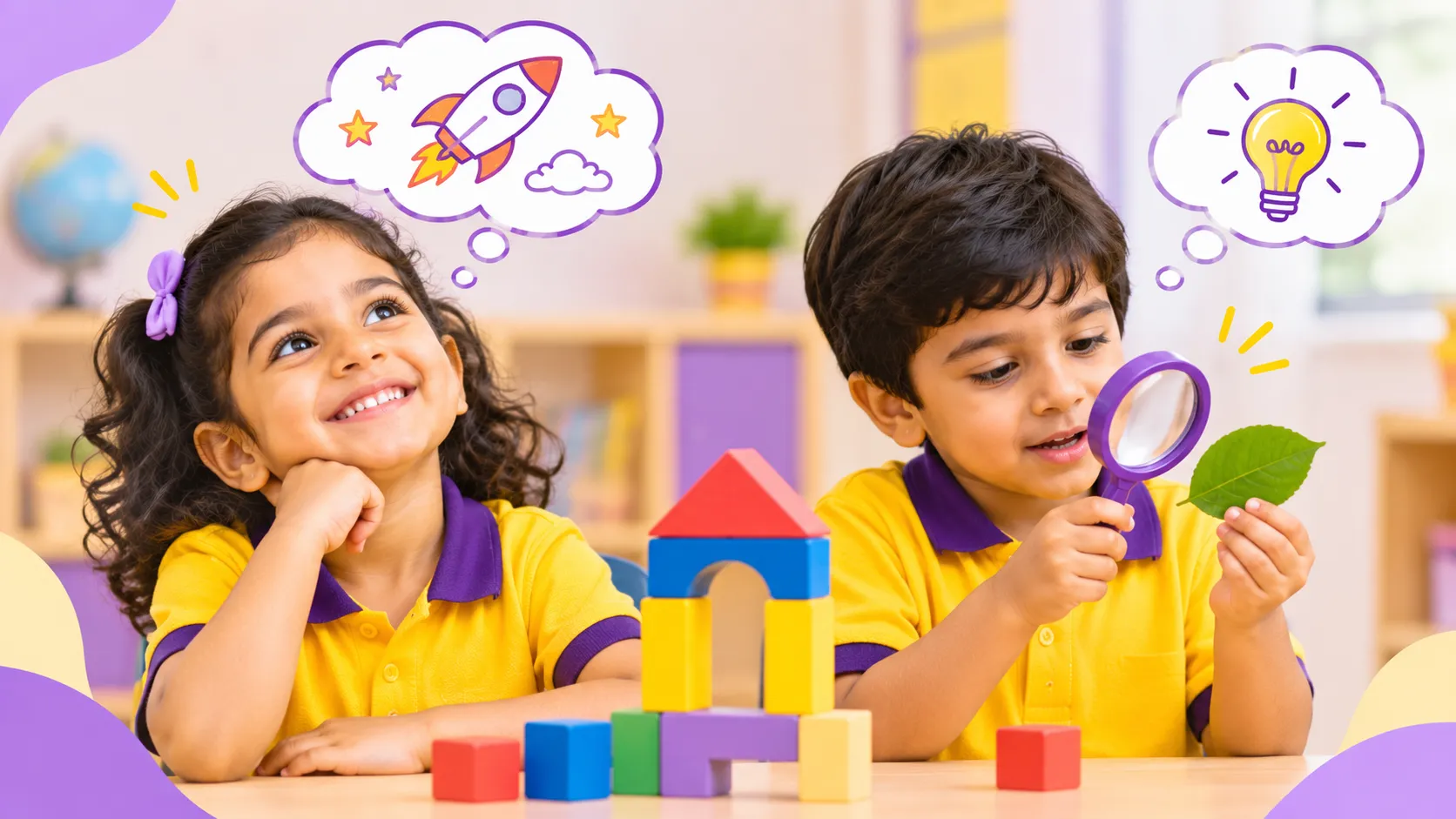
What is the difference between creative and critical thinking in children? Discover why both matter and 8 simple ways to develop these skills at home.




As parents, we love watching our little ones imagine, explore and make sense of the world—whether they're turning a cardboard box into a spaceship, solving a puzzle or wondering, ‘why is the moon following us?’
These everyday moments nurture two essential skills: creative thinking and critical thinking. While they're different, they develop hand in hand during the preschool years (ages 2–5) through play, exploration and meaningful interactions with caring adults.
Creative thinking helps children imagine new ideas and possibilities, while critical thinking helps them question, compare and work out whether those ideas make sense. Both skills begin developing through everyday experiences such as pretend play, puzzles, storytelling, building activities and conversations. During the preschool years, parents and teachers can nurture them by giving children opportunities to explore, experiment and find their own solutions.
Let's explore what these skills mean, why they matter, and how you can nurture them at home.
What Is Creative Thinking?
Creative thinking is the ability to imagine, explore possibilities and come up with original ideas or different ways of doing things. It allows children to look beyond the obvious, experiment with possibilities and express their ideas in their own way.
For a preschooler, creative thinking may look like:
- Pretending a spoon is a microphone.
- Building an imaginary zoo with blocks.
- Creating stories for their toys.
- Mixing colours to discover new shades.
- Finding different ways to play with everyday objects.
It's important to remember that creativity isn't limited to art, music or dance. It is a way of thinking that helps children become flexible, curious and open to new possibilities.
What Is Critical Thinking?
Critical thinking is the ability to observe, compare, question, reason and make simple decisions based on what children experience. It helps them understand cause and effect, recognise patterns, solve problems and learn from trial and error.
At this age, critical thinking does not mean analysing complex problems. It begins with simple actions such as noticing differences, asking questions, trying something out and learning from what happens.
In preschoolers, critical thinking develops when they:
- Decide which puzzle piece fits.
- Compare two objects and identify similarities and differences.
- Predict what might happen next in a story.
- Experiment with different ways to keep a block tower standing.
- Ask questions such as, ‘why did this happen?’ or ‘what if I try it another way?’
Imagine your child wants to build a bridge with blocks. Their creativity helps them imagine different bridge designs. Their critical thinking helps them test which design is strongest, understand why one collapses and make changes to improve it.
The simplest way to understand the difference is this: creative thinking is about generating possibilities, while critical thinking is about evaluating those possibilities. Creative thinking asks, ‘what could I create?’; critical thinking asks, ‘will this work, and how can I make it better?’
Neither skill is more important than the other. Creative thinking sparks new ideas and encourages children to imagine different possibilities, while critical thinking helps them make sense of those ideas, solve problems and make thoughtful decisions. One fuels imagination by encouraging children to explore many possibilities, while the other provides direction by helping them identify the most effective solution for a given situation.
Together, these skills teach children how to think, not just what to think, helping them grow into confident learners, curious problem-solvers and independent thinkers.
Difference between Creative Thinking and Critical Thinking
|
Creative thinking |
Critical thinking |
|
Imagines different possibilities |
Examines and evaluates possibilities |
|
Asks, “What else could I try?” |
Asks, “Why did this happen?” |
|
Encourages imagination and originality |
Encourages reasoning and problem-solving |
|
Explores different ways to build |
Tests which building method works |
|
Generates ideas |
Helps improve and refine ideas |
Why These Skills Matter in Early Childhood
The preschool years are a crucial time for brain development, when everyday experiences strengthen the neural connections that support learning, language, memory and self-regulation. This is also when the foundations of creative and critical thinking begin to develop.
Early childhood is an important period for developing the skills that support learning, communication and problem-solving. The National Curriculum Framework for the Foundational Stage recognises play, activity and inquiry-based experiences as important ways for young children to explore, experiment, develop logical thinking and solve problems. Harvard University's Center on the Developing Child also explains how executive function skills develop through practice and supportive interactions.
Executive function refers to a group of skills that help children focus, remember instructions, manage impulses and adapt when situations change. These abilities develop gradually through everyday experiences, practice and supportive interactions.
That's why creative and critical thinking are best nurtured through play, conversation and guided discovery rather than formal instruction, helping children become confident, capable learners.
Simple Ways Parents Can Nurture Both Skills
The good news is that you don't need expensive toys or extra classes. Everyday moments at home can become powerful learning opportunities when children are given the time, space and encouragement to explore.
Give Children Time to Explore Independently
Let your child investigate, experiment and make discoveries through activities like building with blocks, watering plants, playing with sand or exploring everyday household objects. Resist the urge to direct every activity—children often learn the most when they are free to explore, experiment and discover at their own pace.
Ask Open-Ended Questions That Make Children Think
Replace questions with one right answer, such as "What colour is this?", with "What do you think would happen if we mixed these colours?" or "Can you think of another way to build this?" Open-ended questions spark imagination and reasoning.
Encourage Curiosity and Ask “Why?” Together
When your child asks "Why?", encourage them to think by asking, "What do you think?" Listening to their ideas builds confidence and independent thinking.
Introduce Age-Appropriate Puzzles and Challenges
Puzzles, matching games, building towers and simple household tasks encourage children to observe, compare, experiment and solve problems. Praise effort and persistence as much as the outcome.
Make Room for Creative Activities and Pretend Play
Creativity isn't limited to art. Singing, storytelling, pretend play, dancing, painting or building with recycled materials all help children think flexibly and express themselves.
Use Storytelling to Develop Imagination and Reasoning
During storytime, ask questions like "What do you think will happen next?", "Why does the character feel this way?" or "Can you imagine a different ending?" These conversations build language, empathy, creativity and critical thinking.
Use Everyday Play to Build Problem-Solving Skills
Whether you're building a fort, baking, completing a puzzle or creating an obstacle course, shared play encourages children to test ideas, solve problems and collaborate.
Let Children Reflect and Try Again
If something doesn't work, avoid rushing to fix it. Instead, ask, "What else could we try?" Giving children time to reflect helps build resilience and problem-solving skills.
Take Learning Outdoors Through Observation and Discovery
Nature is a wonderful classroom. Observing insects, collecting leaves or simply wondering about the clouds encourages curiosity, observation and creative exploration.
When your child is drawing, building or playing, try asking questions such as:
- What else could we make with these blocks?
- What do you think will happen if we add another block?
- How could we solve this differently?
Give your child time to answer. There is no need to rush in with the correct response.
Offer Age-Appropriate Challenges
A younger child might enjoy sorting objects by colour or shape, while an older preschooler may be ready to complete a simple puzzle, follow a sequence or build a structure using a picture as a guide. Adjust the activity to your child's interests and abilities.
Encourage Reflection
If a tower falls, rather than rebuilding it immediately, ask, “What do you think made it fall?” or “What could we change this time?” This helps children see mistakes as opportunities to try a different approach.
Explore the Outdoors
During a walk, ask your child to notice how two leaves are different, guess where an ant might be going or describe the shapes they see in the clouds. These small conversations encourage observation and imaginative thinking.
How Do Creative and Critical Thinking Work Together?
Creative and critical thinking are not separate skills that children use one at a time. They often work together during everyday activities.
Imagine a child building a house with blocks. Creative thinking helps the child imagine how the house should look and what else could be added. Critical thinking helps them work out how to make the walls stand, which blocks fit best and what to change if the structure falls.
The same happens during pretend play, storytelling, puzzles and outdoor exploration. Children imagine possibilities, try out ideas, observe what happens and make changes.
Giving children the freedom to explore, along with gentle guidance when needed, helps both skills develop together.
In Conclusion
Children don't need to choose between being creative thinkers or critical thinkers—they need opportunities to become both. Every question they ask, every problem they solve and every imaginative game they play helps build skills they'll use throughout life. This is why India's National Education Policy (NEP 2020) places such strong emphasis on play-based, experiential and inquiry-driven learning during the early years.
After all, every great discovery, invention and brilliant idea begins with a child who is free to wonder!