

Parts of a Flower & Their Functions Explained for Kids
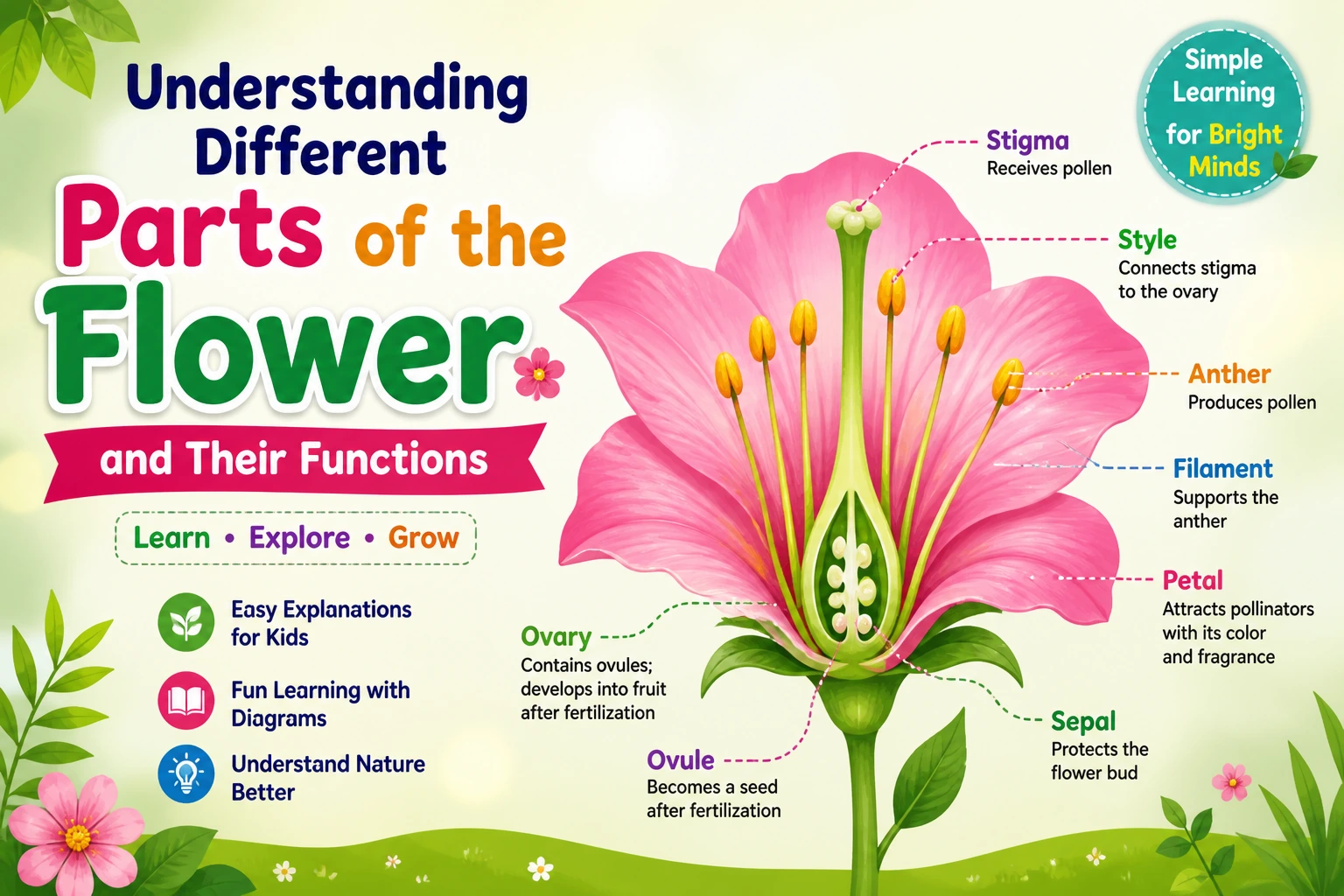
Learn the parts of a flower and their functions in a simple way for kids. Includes diagram, names, and easy explanations for better understanding.



Flowers are among the most fascinating elements of nature. Their colours, fragrance, and delicate structures often capture a child’s curiosity instantly. For young learners, observing a flower is not only a sensory experience but also an opportunity to begin exploring basic science concepts.
When parents explain the flower parts and functions, children begin to understand how plants grow and reproduce. Learning the parts of a flower for kids in simple ways encourages observation, curiosity, and respect for nature. At Kidzee, nature-based learning experiences help build early scientific thinking while keeping learning joyful and meaningful.
Let’s explore parts of a flower in a simple way so you can support your child’s discovery at home.
Why Children Should Learn About Flower Parts
Young children are naturally curious about the world around them. When parents encourage them to observe flowers, ask questions, and label different parts, it strengthens early learning skills.
Here is why exploring the parts of a flower diagram can be beneficial:
- Builds observation skills
Children learn to look closely at shapes, colours, and patterns.
- Introduces early science concepts
Understanding plant structures helps develop foundational knowledge in biology.
- Encourages curiosity and questioning
Children start asking how flowers grow and why they look different.
- Supports creativity
Drawing and colouring parts of a flower diagram combines art with learning.
For pre-schoolers, learning through real objects like flowers makes concepts easier to understand and remember.
The Four Main Parts of a Flower and Their Functions
When children begin to name the different parts of a flower, it is helpful to start with the basic structures. Scientists often describe the 4 main parts of a flower and their functions as sepals, petals, stamens, and pistils.
1. Sepals – The Flower’s Protective Layer
Sepals are the green leaf-like structures found at the base of a flower. Their main role is to protect the flower when it is still a bud. They shield the developing flower before it blooms.
You can tell your child that sepals act like a small blanket that keeps the baby flower safe until it is ready to open.
2. Petals – The Colourful Attraction
One of the most recognisable flower structures is the petal. Many parents often ask, what is petal in a flower, and why is it important.
Petals are the colourful parts surrounding the centre of the flower. Their bright colours and pleasant fragrance attract pollinators such as bees, butterflies, and birds. Their main role is to attract pollinators, which helps the plant reproduce.
You can explain petals to children by comparing them to the flower’s colourful outfit that helps them stand out in the garden.
3. Stamens – The Male Part of a Flower
The male part of a flower is called the stamen. This structure produces pollen, which plays a crucial role in plant reproduction.
The stamen has two main parts:
- Anther: Produces pollen grains
- Filament: A thin stalk that holds the anther in place
When pollen from the anther reaches the female part of another flower, it helps in forming seeds.
To make this easier for children, you can describe pollen as tiny grains or “magic dust” that help flowers create new plants.
4. Pistil – The Female Part of the Flower
The pistil, also known as the carpel, is the female reproductive part of a flower. It is usually located in the centre.
The pistil has three important sections:
- Stigma: The sticky top that catches pollen
- Style: A tube-like structure that connects the stigma to the ovary
- Ovary: The part where seeds begin to form
When pollen reaches the stigma, it travels through the style and reaches the ovary, allowing seeds to develop.
For young children, you can explain this by saying the pistil is the part that helps the flower grow seeds.
Other Supporting Parts of a Flower
While the four main structures are most commonly taught, flowers also have additional parts that support their growth.
Receptacle
This is the base that holds all the flower parts together.
Pedicel
This is the stalk that attaches the flower to the plant.
Although these parts are smaller and less visible, they help the flower stay connected to the plant and receive nutrients.
Write the Names of the Parts of a Flower
To help children remember what they learn, parents can encourage them to write the names of the parts of a flower while looking at a simple illustration.
A basic list children can learn includes:
- Sepals
- Petals
- Stamen (male part)
- Pistil (female part)
- Anther
- Filament
- Stigma
- Style
- Ovary
Using a parts of a flower diagram during this activity makes learning more visual and engaging.
Simple Ways Parents Can Explain Parts of Flower at Home
Children between the ages of two and six learn best through hands-on exploration. Parents can make learning about flowers both fun and meaningful with a few simple activities.
1. Explore a Real Flower
Choose a simple flower like a hibiscus or marigold, and observe it together.
Ask your child questions such as:
- What colour are the petals?
- How many petals can you count?
- Can you see the centre of the flower?
This activity helps children naturally begin to explain parts of a flower in their own words.
2. Draw a Flower Diagram
Encourage your child to draw a flower and label its parts. This creative activity improves both understanding and fine motor skills.
You can guide them to label:
- Petals
- Sepals
- Stamen
- Pistil
This is one of the easiest ways for children to name the different parts of a flower.
3. Go on a Nature Walk
During a park or garden visit, invite your child to observe different flowers.
Ask questions like:
- Which flower has the biggest petals?
- Which flower smells the strongest?
- Do all flowers look the same?
This encourages curiosity and deeper observation.
4. Turn It Into a Story
Young children enjoy stories. You can describe the flower as a small team where each part has a special job.
For example:
- Petals are the friendly greeters attracting bees.
- Stamens make pollen.
- Pistils help seeds grow.
Storytelling helps children remember flower parts and functions more easily.
How Nature Learning Supports Holistic Development
At Kidzee, early learning is not limited to textbooks. Activities like exploring flowers connect children with the natural world and encourage multiple aspects of development.
Learning about flowers can support:
- Cognitive development – understanding basic science concepts
- Creativity – drawing, colouring, and storytelling
- Language skills – learning new words and asking questions
- Emotional connection with nature – appreciating plants and living things
Such experiences nurture curiosity and help children develop a lifelong love for learning.
Nurturing Curiosity Through Daily Moments
Understanding flowers goes beyond memorising names. When children explore nature with their parents, they begin to see how every part of a plant has a purpose.
By helping your child observe, draw, and discuss flowers, you are supporting their early scientific thinking. Whether it is identifying the male part of a flower, understanding the petal function in a flower, or learning the 4 main parts of a flower and their functions, each small discovery contributes to their learning journey.
At Kidzee, we believe that curiosity is the first step towards lifelong learning. Through simple explorations like studying flowers, parents and educators together can inspire children to ask questions, observe the world closely, and grow with confidence.
Because when curiosity blooms, learning blossoms too.
FAQs
1. What are the main parts of a flower and their functions?
A flower has several important parts that work together to help the plant grow and reproduce. The main parts of a flower include petals, sepals, stamen, pistil, ovary, stigma, style, and stem. Petals attract pollinators like bees and butterflies with their bright colours and fragrance, while sepals protect the flower bud before it blooms. The stamen is the male part that produces pollen, and the pistil is the female part where seeds develop. Learning about flower parts helps children understand how plants grow and reproduce in nature.
2. What is the function of petals in a flower?
Petals are the colourful parts of a flower that help attract insects, birds, and pollinators such as bees and butterflies. Their bright colours and fragrance encourage pollination, which is an important process for plant reproduction. In many flowers, petals also help protect the inner reproductive parts. Teaching children about petals helps them understand how flowers interact with nature and support the ecosystem.
3. What does the stamen do in a flower?
The stamen is the male reproductive part of a flower and is responsible for producing pollen. It usually consists of two parts called the anther and filament. The anther produces pollen grains, while the filament supports the anther. During pollination, pollen is transferred to the female part of the flower to help create seeds. Understanding the role of the stamen helps children learn how plants reproduce and grow new flowers.