
How to Encourage Curiosity in Young Children: Simple Ways to Spark a Love of Learning
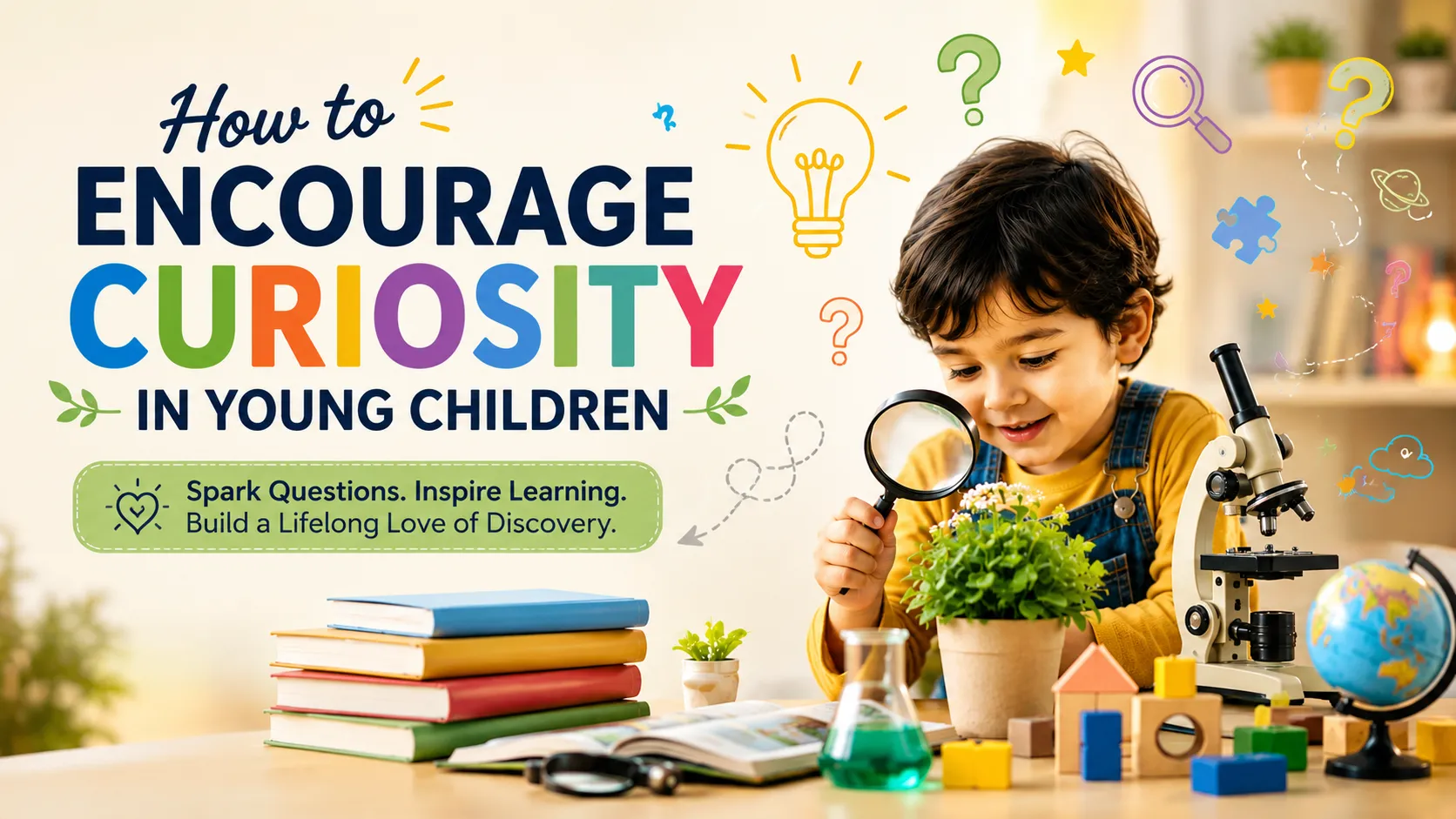
Want to raise curious, confident learners? Discover expert-backed strategies to encourage curiosity, creativity, and exploration in young children.




Encouraging curiosity in young children involves creating opportunities for exploration, asking open-ended questions, supporting play-based learning, and allowing children to discover answers through hands-on experiences. Curiosity helps develop critical thinking, creativity, problem-solving skills, and a lifelong love of learning.
“Why is the moon following our car?”
“Can ants sleep?”
“What happens if I mix orange juice with milk?”
If you are parenting a young child, chances are your day is powered by questions - endless, delightful and occasionally exhausting questions. And while it may feel tempting to respond with a quick “because I said so” during a busy weekday morning, these little moments are signs of something wonderful: curiosity at work.
Curiosity is one of the most important qualities a child can develop in the early years. It is the foundation of learning, creativity, confidence, problem-solving, and independent thinking. Long before children learn to read or write, they learn by wondering, observing, experimenting, and asking questions.
In today’s fast-moving world, where achievement often takes centre stage early, nurturing curiosity can sometimes get overlooked. Yet the children who thrive in the long run most are often not the ones who know all the answers — but the ones who are excited to discover them.
Curiosity in Early Childhood
Young children are natural explorers. Every puddle is a science experiment. Every cardboard box is a spaceship. Every ‘why’ is their way of understanding how the world works.
Research consistently shows that curious children are more engaged learners. They develop stronger language skills, better memory, and greater emotional resilience. More importantly, curiosity builds a lifelong love for learning — something no worksheet can truly teach.
While many parents focus on school readiness, academic milestones, and structured learning, curiosity gives children the confidence to think beyond memorisation and become active learners, not passive receivers of information.
Some of the best learning happens far from a textbook!
Create Space for Questions
The simplest way to encourage curiosity is to welcome questions, with interest.
When a child asks, ‘Why do leaves fall?’ try responding with interest instead of rushing to provide the perfect answer.
Try: “That’s such an interesting question, what do you think happens?”
This small shift invites children to think, predict, and engage in conversation.
Of course, there will also be days when the twentieth ‘why’ arrives just as you are replying to work emails while rescuing dal from boiling over. That is perfectly normal. Parenting curious children requires patience — and occasionally, caffeine.
Independent Exploration
Children learn deeply when they have opportunities to explore freely.
-
Nature walks in the garden or park
-
Water play with cups and spoons
-
Building with blocks
-
Sorting kitchen items by colour or size
-
Gardening with grandparents
-
Helping knead atta in the kitchen
Everyday experiences nurture observation, problem-solving, and creativity – when adults naturally step in to help children quickly (tying shoes, fixing puzzles, completing tasks), children miss valuable opportunities to struggle, persist, and problem-solve independently.
Read Together
Books are one of the most powerful tools for nurturing curiosity. Reading together introduces children to new ideas, places, emotions, and experiences.
But curiosity grows even more when reading becomes interactive.
Ask questions like:
-
‘What do you think happens next?’
-
‘Why do you think the character felt sad?’
-
‘What would you do?’
Even picture books without many words can lead to rich conversations.
For Indian families raising multilingual children, storytelling in home languages is equally valuable. Whether it is a bedtime story in English, Hindi, Tamil, Marathi, or Bengali, language-rich interactions help children think more deeply and express themselves confidently.
Process Over Performance
Children become more curious when they feel safe making mistakes.
If every activity becomes about the ‘right answer,’ children may stop experimenting altogether. Instead, praise effort, creativity, and thinking.
Rather than: “Good job, you got it right!”, try: “I love how you kept trying different ways.” This builds confidence and encourages children to explore without fear of failure.
Inquiry-based learning encourages children to ask questions, investigate ideas, and participate actively in learning experiences — not simply memorise information.
Saying, “I don’t know — let’s find out together” is a powerful tool. Children do not need parents to have all the answers. They need adults who are excited to keep learning.
Slow Down
In busy urban life, schedules often fill up quickly: phonics classes, dance lessons, swimming, playdates, activity kits. While enrichment has its place, children also need unstructured time to simply notice the world around them.
A butterfly on the balcony.
Clouds before the monsoon.
The sound of pressure cooker whistles from neighbouring homes.
The excitement of spotting a rainbow during rains.
Wonder lives in ordinary moments.
And when adults pause to notice these moments with children, curiosity naturally grows.
In Conclusion
The goal is to raise a child who is eager to learn, confident to ask questions, and excited to discover the world.
Curiosity cannot be forced through flashcards or accelerated through pressure. It grows best in environments where children feel secure, heard, encouraged, and inspired.
The next time your child asks an unexpected question at bedtime — perhaps about dinosaurs, stars, or why bananas turn brown — take a moment before answering.
That little question may be the beginning of a lifelong love for learning.
FAQs:
1. Why is curiosity important in young children?
Curiosity is essential because it drives learning, exploration, and problem-solving. Curious children are more likely to ask questions, develop critical thinking skills, build creativity, and become confident lifelong learners.
2. How can parents encourage curiosity in young children?
Parents can encourage curiosity by answering questions patiently, providing opportunities for exploration, reading together, encouraging hands-on activities, and creating an environment where children feel safe to ask questions and experiment.
3. What activities help develop curiosity in children?
Activities such as nature walks, science experiments, storytelling, puzzles, arts and crafts, sensory play, and open-ended games help children explore new ideas and develop a natural sense of curiosity.
4. How does play encourage curiosity and learning?
Play allows children to discover, experiment, and solve problems independently. Through play, children learn how things work, develop creativity, and gain confidence in exploring new concepts and ideas.
5. What are open-ended questions and why are they important?
Open-ended questions are questions that cannot be answered with a simple "yes" or "no." They encourage children to think deeply, express ideas, and explore possibilities, helping to strengthen curiosity and communication skills.
Examples:
- What do you think will happen next?
- Why do you think that happened?
- How could we solve this problem?
6. Can curiosity improve a child's academic performance?
Yes. Curious children are often more engaged in learning, better at problem-solving, and more motivated to seek knowledge. Research shows that curiosity can support stronger academic achievement and long-term educational success.
7. How can teachers foster curiosity in the classroom?
Teachers can foster curiosity by encouraging questions, using hands-on learning activities, promoting exploration, introducing real-world problems, and creating a classroom environment where inquiry and discovery are valued.
8. Does technology help or hinder curiosity in children?
Technology can support curiosity when used appropriately. Educational apps, interactive learning tools, and virtual experiences can inspire exploration. However, excessive passive screen time may reduce opportunities for hands-on discovery and social interaction.
9. What role does reading play in developing curiosity?
Reading exposes children to new ideas, cultures, experiences, and perspectives. Books often spark questions, imagination, and discussions, making reading one of the most effective ways to nurture curiosity.
10. How can parents respond when children ask many questions?
Parents should welcome questions with patience and enthusiasm. If they do not know the answer, they can explore it together with the child. This teaches children that learning is a continuous process and encourages further inquiry.
11. Can curiosity help children develop problem-solving skills?
Yes. Curious children naturally seek answers and explore different solutions. This process strengthens analytical thinking, creativity, decision-making, and resilience when facing challenges.
12. What are signs of a curious child?
Common signs include:
- Frequently asking "why," "how," and "what if" questions
- Exploring new environments
- Showing interest in how things work
- Enjoying experiments and discovery activities
- Demonstrating creativity and imagination
- Seeking new experiences and knowledge
13. How can curiosity be encouraged without overwhelming a child?
Curiosity grows best when children have the freedom to explore at their own pace. Parents and educators should provide guidance, resources, and encouragement while avoiding excessive pressure or structured expectations.
14. What mistakes can discourage curiosity in children?
Some common mistakes include:
- Dismissing or ignoring questions
- Providing all the answers immediately
- Over-scheduling activities
- Criticizing mistakes
- Discouraging experimentation
- Focusing only on correct answers instead of exploration
15. What is the best way to nurture lifelong curiosity in children?
The best way is to create a supportive environment that values questions, exploration, creativity, reading, and hands-on learning. When children feel encouraged to discover and think independently, curiosity becomes a lifelong habit.