
Language Development Milestones: 1 to 5 Years Explained for Parents
Explore language development milestones in children aged 1 to 5 years. Learn how speech, communication, vocabulary, and listening skills grow during early childhood.




There are few experiences as remarkable as watching a young child discover language. Over decades of working in preschools, I have witnessed countless first words, curious questions, invented stories, and joyful conversations. Language development is not merely about speaking; it is about connection, confidence, thinking, and understanding the world.
Every child develops at their own pace, yet there are broad milestones that help us understand how communication skills typically grow between the ages of one and five. These early years are incredibly important because they form the foundation for future learning, social relationships, reading, and emotional expression.
As parents and educators, our role is not to rush children through these stages, but to nurture them patiently with rich conversations, storytelling, songs, play, and attentive listening.
The First Year to Eighteen Months: The Beginning of Meaningful Communication
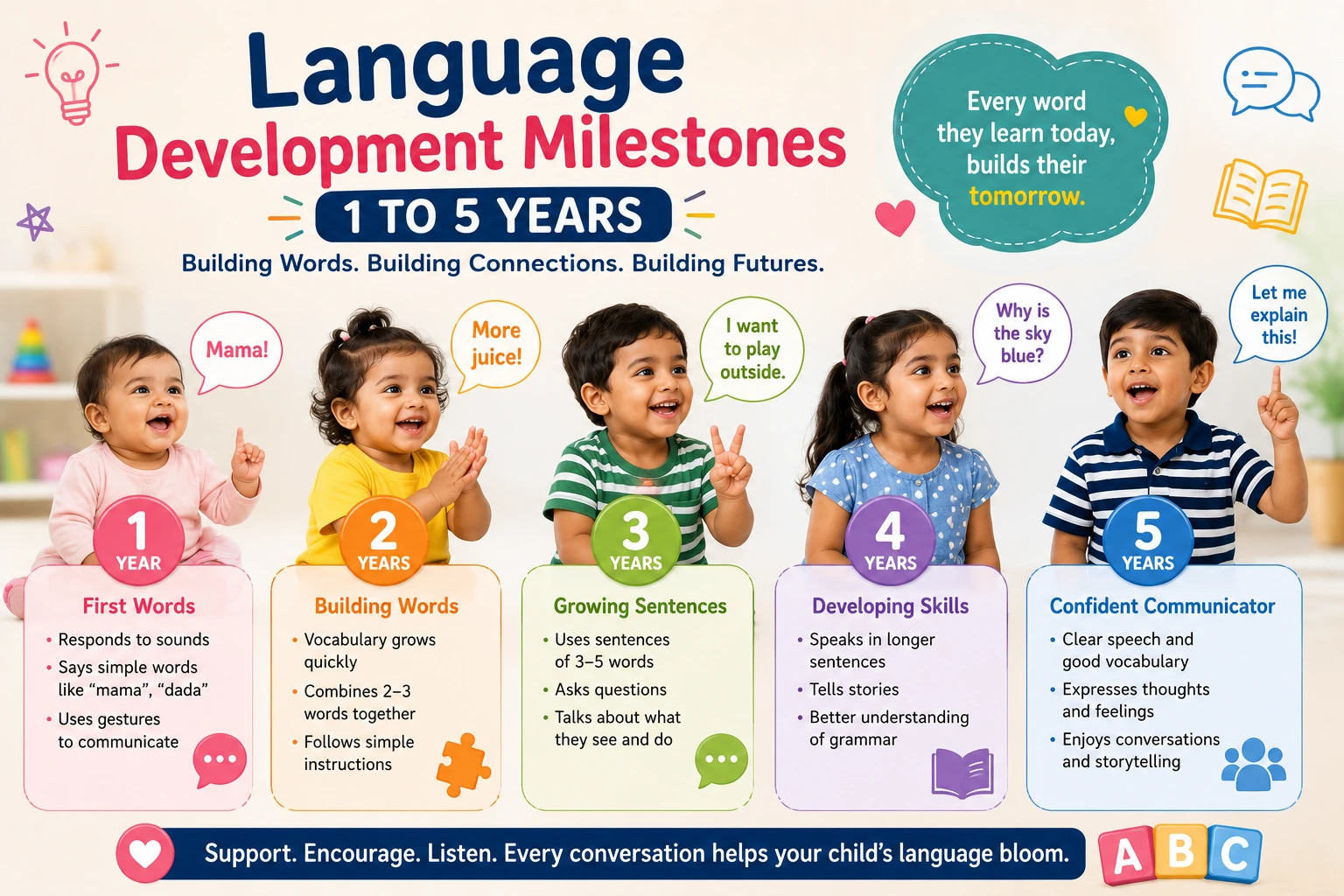
Around a child’s first birthday, language truly begins to blossom. Before words appear, babies have already been communicating through eye contact, gestures, sounds, smiles, and cries. By 12 months, many children begin saying simple words such as “mama,” “dada,” “bye,” or the names of familiar objects and people.
At this stage, children usually:
-
Respond to their name
-
Understand simple instructions like “Come here”
-
Use gestures such as waving or pointing
-
Attempt to imitate sounds and words
-
Say one to five meaningful words
One of the most important developments during this period is understanding. Children often comprehend far more language than they can speak. Parents sometimes worry because their child is not talking much, but receptive language, that is, the ability to understand —develops first.
The best support during this stage comes through constant interaction. Talk to children throughout the day. Describe routines, name objects, sing rhymes, and respond warmly to every attempt at communication.
Eighteen Months to Two Years: The Vocabulary Explosion
This is one of the most exciting phases in language development. Suddenly, children begin acquiring words rapidly. A child who spoke only a handful of words a few months earlier may now begin naming everything they see.
By age two, many children:
-
Use 50 or more words
-
Combine two words together such as “more juice” or “mummy come”
-
Follow simple two-step instructions
-
Identify familiar people and body parts
-
Enjoy listening to stories and songs repeatedly
This is also the age of endless curiosity. Children begin to realise that words have power. They ask for things, express preferences, and communicate emotions more clearly.
In preschool classrooms, this stage is filled with delightful attempts at conversation. Pronunciation may still be unclear, but intent and enthusiasm are unmistakable.
Parents should remember that repetition is essential. Young children learn language through hearing words used naturally again and again.
Two to Three Years: Conversations Begin
Between two and three years, language becomes more organised and expressive. Children begin forming short sentences and engaging in simple conversations. Their personality starts shining through their words.
Typical milestones include:
-
Speaking in three- to four-word sentences.
-
Asking simple questions like “What’s that?”
-
Using pronouns such as “me,” “mine,” and “you.”
-
Understanding basic concepts like big/small or up/down.
-
Being understood by familiar adults most of the time.
Imagination also flourishes during this stage. Pretend play becomes richer, and children begin creating small narratives during playtime.
This is a wonderful age for storytelling, role play, puppet conversations, and picture books. Children benefit enormously from adults who listen patiently and expand on what they say.
For example, if a child says, “Dog running,” an adult might respond, “Yes, the brown dog is running very fast in the park.”
Such expansions gently model richer language without correcting or discouraging the child.
Three to Four Years: Language and Imagination Grow Together
By age three or four, children often become enthusiastic talkers. They begin expressing ideas, describing experiences, and asking many “why” questions.
At this stage, children generally:
-
Speak in longer sentences.
-
Retell simple events or stories.
-
Understand and use basic grammar.
-
Enjoy rhyming words and silly language.
-
Participate in group conversations.
-
Ask frequent questions about the world.
This period is deeply connected to cognitive development. Language now supports thinking, problem-solving, and social interaction.
In the preschool environment, circle time discussions become especially meaningful during these years. Children learn to wait for turns, listen to peers, express opinions, and negotiate during play.
Adults should encourage open-ended conversations rather than only asking factual questions. Instead of “What colour is this?” we might ask, “What do you think will happen next?” Such questions stimulate richer thinking and expression.
Four to Five Years: Preparing for School and Beyond
By the age of five, most children can communicate clearly enough to be understood by unfamiliar listeners. Their vocabulary expands dramatically, and they begin using language in sophisticated ways.
Children at this stage often:
-
Speak in complete, detailed sentences
-
Tell stories with a beginning, middle, and end
-
Understand time-related words such as yesterday and tomorrow
-
Recognise rhyming patterns and beginning sounds
-
Follow multi-step directions
-
Use language to negotiate, explain, and imagine
These years lay the groundwork for literacy. Children become increasingly aware of sounds, letters, patterns, and storytelling structures.
Importantly, language development is not only academic preparation. It is closely tied to emotional well-being. A child who can express feelings clearly is often better equipped to manage frustration, build friendships, and develop confidence.
The Role of Adults in Language Development
It is a well-known fact that children learn language best through loving human interaction.
No toy, flashcard, or digital program can replace responsive conversation. Children need adults who listen, respond, sing, read aloud, and engage with genuine interest.
Simple daily moments become powerful learning opportunities:
-
Talking during meals
-
Naming objects during walks
-
Singing bedtime songs
-
Reading stories repeatedly
-
Encouraging pretend play
-
Listening without rushing
Language grows in relationships.
Final Thoughts
Every child’s voice unfolds in its own unique rhythm. Some children speak early and endlessly, while others observe quietly before suddenly blossoming into confident communicators. The journey from first words to full conversations between ages one and five is extraordinary to witness.
As educators and parents, our responsibility is not to compare children, but to provide warmth, patience, and opportunities for meaningful communication.
When children feel heard, valued, and encouraged, language develops naturally — and with it, the confidence to explore the world.
FAQs
1. What are the normal language development milestones from 1 to 5 years?
Language development milestones between 1 and 5 years include first words, vocabulary growth, sentence formation, storytelling, and conversational skills. By age 1, most children say simple words, while by age 5, many can communicate clearly, ask questions, and express thoughts confidently. These milestones help parents track speech, communication, and cognitive development during early childhood.
2. At what age should a child start talking clearly?
Most children begin using simple words around 12 months and start forming short sentences between 2 and 3 years of age. By 4 to 5 years, children usually speak more clearly and communicate in complete sentences. Every child develops differently, but steady progress in vocabulary and communication is an important sign of healthy language development.
3. How can parents support language development in young children?
Parents can support language development by talking regularly with children, reading storybooks, singing songs, encouraging conversations, and asking open-ended questions. Interactive communication and responsive listening help children improve vocabulary, pronunciation, comprehension, and confidence in speaking naturally.
4. What are the signs of speech delay in toddlers?
Common signs of speech delay include limited vocabulary for age, difficulty forming words, lack of response to sounds or names, trouble following instructions, and reduced social communication. If language milestones are significantly delayed between ages 1 and 5, parents may consider consulting a child development or speech specialist for guidance.
5. Why is early language development important for children?
Early language development plays a major role in communication, emotional expression, social interaction, learning ability, and academic readiness. Strong speech and language skills help children build confidence, improve relationships, understand instructions, and perform better in preschool and school environments.
6. How does reading help improve language skills in children?
Reading helps children improve vocabulary, listening skills, sentence structure, imagination, and comprehension from an early age. Storytelling and picture books expose children to new words and communication patterns, helping strengthen overall language and cognitive development naturally.
7. Can preschool programmes improve communication and speech development?
Yes, quality preschool programmes support communication and speech development through interactive learning, storytelling, group activities, phonics, music, and classroom conversations. Structured early learning environments help children improve vocabulary, social interaction, listening skills, and confidence in expressing themselves effectively.