NEP 2020 for Preschool: Holistic Learning for Preschoolers
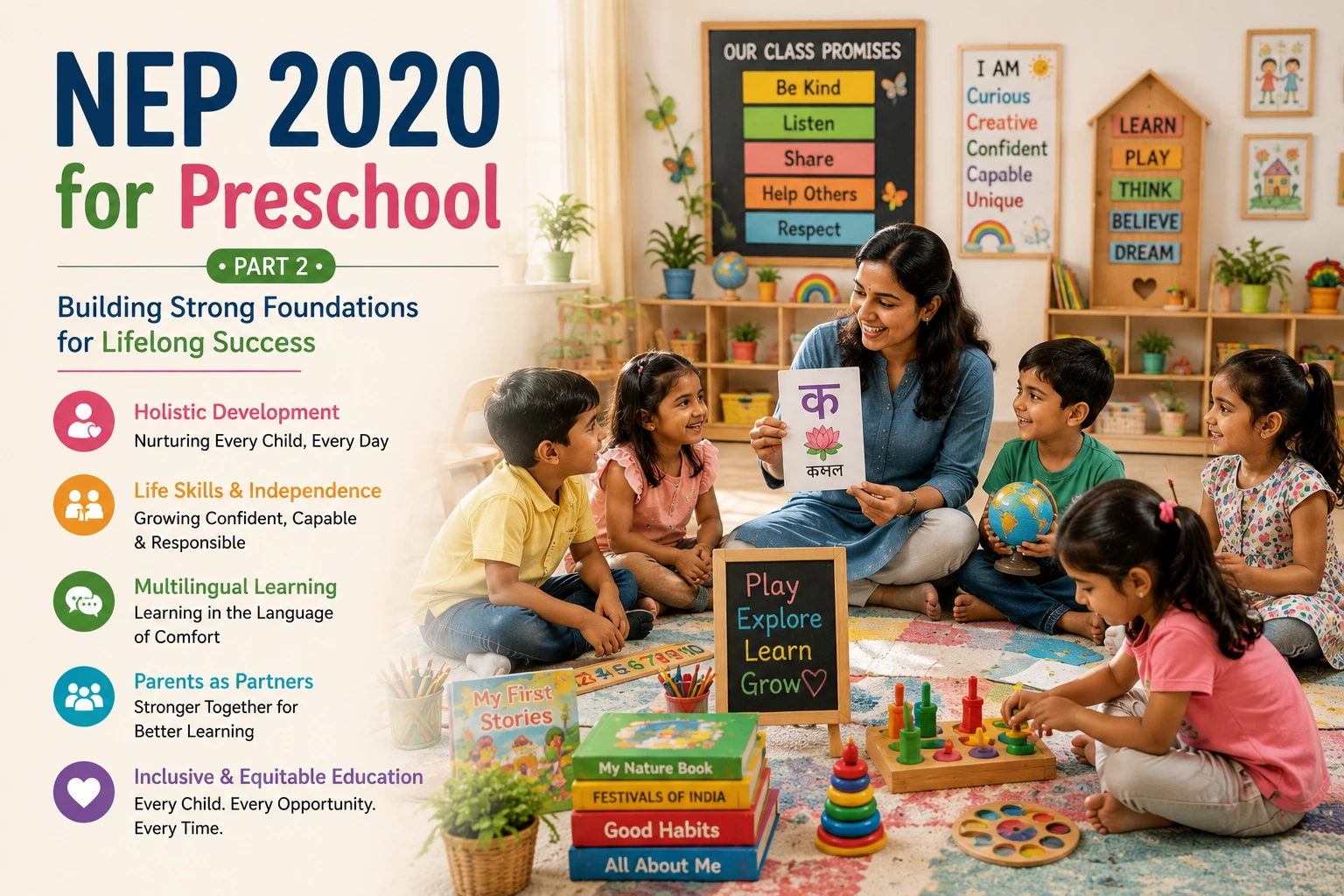
Learn how NEP 2020 prepares preschoolers for lifelong success through holistic development, life skills, multilingual learning, inclusive education, and active parent involvement.




In Part 1, we explored how NEP 2020 is reshaping early childhood education through play-based learning, foundational literacy and numeracy, experiential learning, and school readiness.
Now let's look at what this means for your child's overall development and how families can support this learning journey.
Building Independence and Life Skills
A key goal of NEP is helping children become increasingly independent. Preschool routines gently encourage their learners to:
-
Put away toys after use
-
Wash hands independently
-
Carry their own belongings
-
Eat independently
-
Manage simple routines
These everyday activities build confidence, responsibility, decision-making skills, and self-help abilities.
Most parents celebrate the first neatly written letter. But successfully zipping up a school bag independently deserves applause too!
Focus on Holistic Development
NEP recognises that children develop in many interconnected ways, and not every domain progresses at the same pace for every child. Whether it is cognitive, physical, language and communication, socio-emotional, or creative and aesthetic development, each domain deserves attention. Interdisciplinary experiences help children make connections across domains, deepening understanding and application.
So yes, that blue elephant with pink stripes may look unusual—but it could also be evidence of creativity, confidence, and independent thinking at work.
After all, NEP aims to prepare children not just for school, but for life. The focus has therefore shifted from simply acquiring knowledge to nurturing future-ready competencies that help children thrive in a rapidly changing world.
Teacher as Facilitator, Not Just Instructor
Under NEP, preschool teachers are facilitators of learning rather than instructors who simply deliver information. They guide exploration and support the emotional and learnings needs of children.
A New Approach to Assessment
One of the most reassuring changes under NEP is how children are assessed. There are:
-
No formal exams
-
No rankings
-
No rote-based testing
-
No comparison charts
Instead, teachers observe participation, communication, creativity, problem-solving, emotional development, and social interactions.
Assessment becomes a tool for understanding growth rather than creating pressure.
Your child is not preparing for board exams from the age of four. They are simply growing, learning, and understanding the world around them.
Multilingual Learning
India is beautifully multilingual, and NEP strongly supports learning in the child's home language or mother tongue during the early years.
If your preschooler says: "Aai, I want more doodh please”, it is multilingual learning in action.
Research consistently shows that children learn concepts best when introduced through familiar languages. This also allows them to learn through experiences that connect to their lives, which include:
-
Regional stories
-
Folk songs and rhymes
-
Festival celebrations
-
Family traditions
-
Community experiences
They may explore patterns through rangoli, counting through arranging diyas, measurement while helping in the kitchen, or social values through stories shared by grandparents.
Learning feels meaningful because it is connected to the world children already know.
Parents as Co-Learners and Partners
NEP recognises that learning does not begin and end at school.
Parents play a vital role by:
-
Talking to children regularly
-
Reading together
-
Encouraging questions
-
Limiting excessive screen time
-
Involving children in everyday routines
Sorting vegetables, helping set the table, watering plants, accompanying parents to the market, or helping pack a school bag can all become valuable learning opportunities.
The policy encourages strong partnerships between schools and families, ensuring children receive consistent support across both environments.
It encourages the balanced and age-appropriate use of technology while recognising that young children learn best through direct experiences.
It also places importance on good health, nutrition and general wellbeing of a child as it recognises that a well-rested, active, and emotionally secure child is far more ready to learn than a tired, hungry, or overwhelmed child.
Equity and Inclusion in Early Education
NEP is committed to ensuring quality education for all children. It aims to:
-
Support diverse learning needs
-
Improve access to early childhood education
-
Respect cultural and linguistic diversity
-
Create inclusive learning environments
This is particularly important in a country as diverse as India, where children grow up in nuclear and joint families with very different economic and social backgrounds, speak different languages, and bring unique experiences to their learning journey.
Every child is viewed as capable of learning and deserving of opportunities to thrive.
What NEP Does Not Mean
One common misunderstanding is that NEP means schools may no longer focus on academics. That is not true.
Children will still learn reading readiness, writing readiness, numeracy, communication, and problem-solving skills.
The difference is in how they learn.
The goal is not less learning – but better learning, which is meaningful, engaging, and developmentally appropriate.
Final Thoughts
Understanding NEP 2020 doesn't require an education degree—just a shift in perspective.
From: "What did my child write today?" To: "What did my child explore, experience, create, and understand today?"
So, the next time your preschooler comes home with paint on their hands, sand in their shoes, and an elaborate story about a dinosaur who travelled to the moon, take a moment to smile. Because somewhere between the glitter, giggles, cardboard rockets, pretend play, festival celebrations, and glue sticks, real learning is happening.
If it still looks suspiciously like play, that's because the most meaningful learning in the early years often does. In many ways, this is exactly the vision of the National Education Policy (NEP)— joyful, hands-on learning for young children!