
NEP 2020 for Preschool: How India is Reimagining the Early Years - Part 1
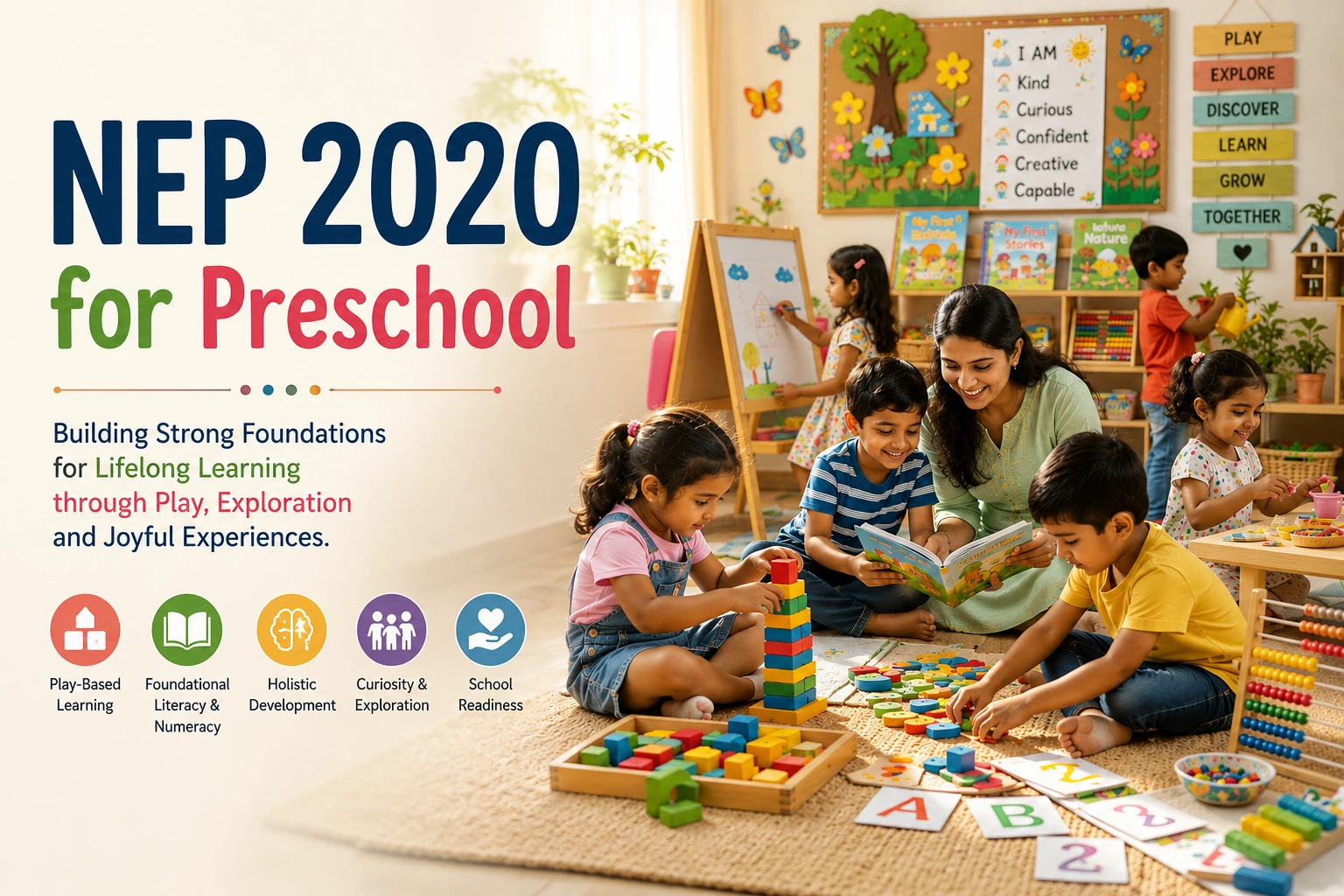
Discover what NEP 2020 means for preschool children, including the Foundational Stage, play-based learning, Foundational Literacy and Numeracy (FLN), and school readiness.




If you've recently heard phrases like ‘NEP 2020’, ‘Foundational Stage’, or ‘FLN’ at your child's preschool and quietly nodded while wondering whether you should have Googled them beforehand—you are certainly not alone.
The National Education Policy 2020 (NEP 2020) is one of the most significant education reforms in India in decades, and it places Early Childhood Education (ECE) firmly in the spotlight. More importantly, it recognises what educators have always known: young children learn best when they are allowed to be children.
The good news? NEP 2020 is designed to make early learning more joyful, meaningful, and developmentally appropriate. It shifts the focus from early academic pressure to building strong foundations for lifelong learning.
Let's explore this a little more in detail in our 2 Part Series on this topic.
The 5+3+3+4 Structure
One of the most talked-about changes under NEP is the new school structure:
-
Foundational Stage (ages 3–8)
-
Preparatory Stage (ages 8–11)
-
Middle Stage (ages 11–14)
-
Secondary Stage (ages 14–18)
For preschool parents, the most important part is the Foundational Stage, which includes three years of preschool and Grades 1 and 2.
This is a significant shift because, for the first time, ECE is formally recognised as the foundation of all future learning.
NEP acknowledges what child development experts have long understood: the early years are critical for brain development. In fact, a large portion of brain development happens before the age of six.
So those moments when your child transforms a cardboard box into a rocket ship, turns the sofa into a mountain, or insists that a spoon is a magic wand? They are not simply playing – but building imagination, language, problem-solving skills, and neural connections that will support future learning.
The policy encourages learning environments that are joyful, engaging, and developmentally appropriate rather than academically pressured.
To bring the vision of NEP to life, India introduced the National Curriculum Framework for the Foundational Stage (NCF-FS), a roadmap that guides how young children should be taught. It emphasises:
-
Play-based learning
-
Experiential learning
-
Discovery and exploration
-
Hands-on activities
-
Local and cultural relevance
-
Learning through stories, songs, games, and conversations
This means children may learn counting through sorting mangoes, language through storytelling, or science concepts by observing birds in the school garden.
Learning is connected to real life, not limited to worksheets and memorisation.
Foundational Literacy and Numeracy: The Real Priority
A key focus of NEP 2020 is Foundational Literacy and Numeracy (FLN)—ensuring that every child develops strong language and mathematical skills by Grade 3.
This includes:
-
Building reading readiness through stories, rhymes, and phonics
-
Strengthening number sense through hands-on experiences
-
Developing listening and comprehension skills
-
Encouraging conceptual understanding rather than rote repetition
Rather than rushing children into writing pages of alphabets and numbers, the focus is on helping them truly understand what they are learning.
After all, being able to count ten laddus is useful. Understanding that five laddus in one hand and five more in the other make ten laddus altogether is even better!
What This Means for Preschool Learning
At its heart, NEP recognises something both teachers and parents already know -children do not learn best by sitting quietly and memorising information. They learn through storytelling, play, outdoor exploration, music and movement, conversation and social interactions, and hands-on experiences focusing on holistic development across all domains.
So, when your child proudly announces that they spent the day ‘playing shopkeeper,’ they may have practised counting, communication, negotiation, problem-solving, and social interaction—all before snack break.
The Shift from ‘Rote Learning’ to ‘Learning by Doing’
Many Indian parents grew up in classrooms where learning often looked like this:
-
Write A to Z ten times
-
Memorise multiplication tables
-
Read and memorise a poem
NEP shifts the focus towards experiential learning.
Children may learn letters by tracing them in sand, forming them with clay, singing phonics songs, or finding objects that begin with a particular sound.
Similarly, numbers are explored through games, sorting activities, counting objects, cooking activities, and real-life situations.
One of the most exciting aspects of NEP is its encouragement of curiosity and inquiry-based learning. Rather than simply providing answers, teachers encourage children to observe, think, predict, and explore answers for themselves.
The goal is not simply to fill children's minds with information, but to help them become curious thinkers who enjoy learning.
This sometimes leaves parents wondering: "Is my child actually studying?"
The answer is yes.
At this age, play is not separate from learning—it is learning.
School Readiness, Not Academic Readiness
One of the biggest misconceptions among parents is that preschool should prepare children primarily for writing and academics.
NEP introduces a broader concept called ‘school readiness’.
A school-ready child can:
-
Communicate basic needs
-
Follow instructions
-
Participate in group activities
-
Manage emotions appropriately
-
Build relationships
-
Show curiosity and confidence
In other words, being able to wait for a turn during circle time is just as important as recognising letters in your child’s educational journey.
In Part 2, we'll explore how NEP supports holistic development, the role of parents, the 7Cs of future-ready learning, multilingual education, assessment, inclusion, and what all of this means for your child's everyday preschool journey.