

Screen Time Guidelines for Children Under 5: What Every Parent Should Know
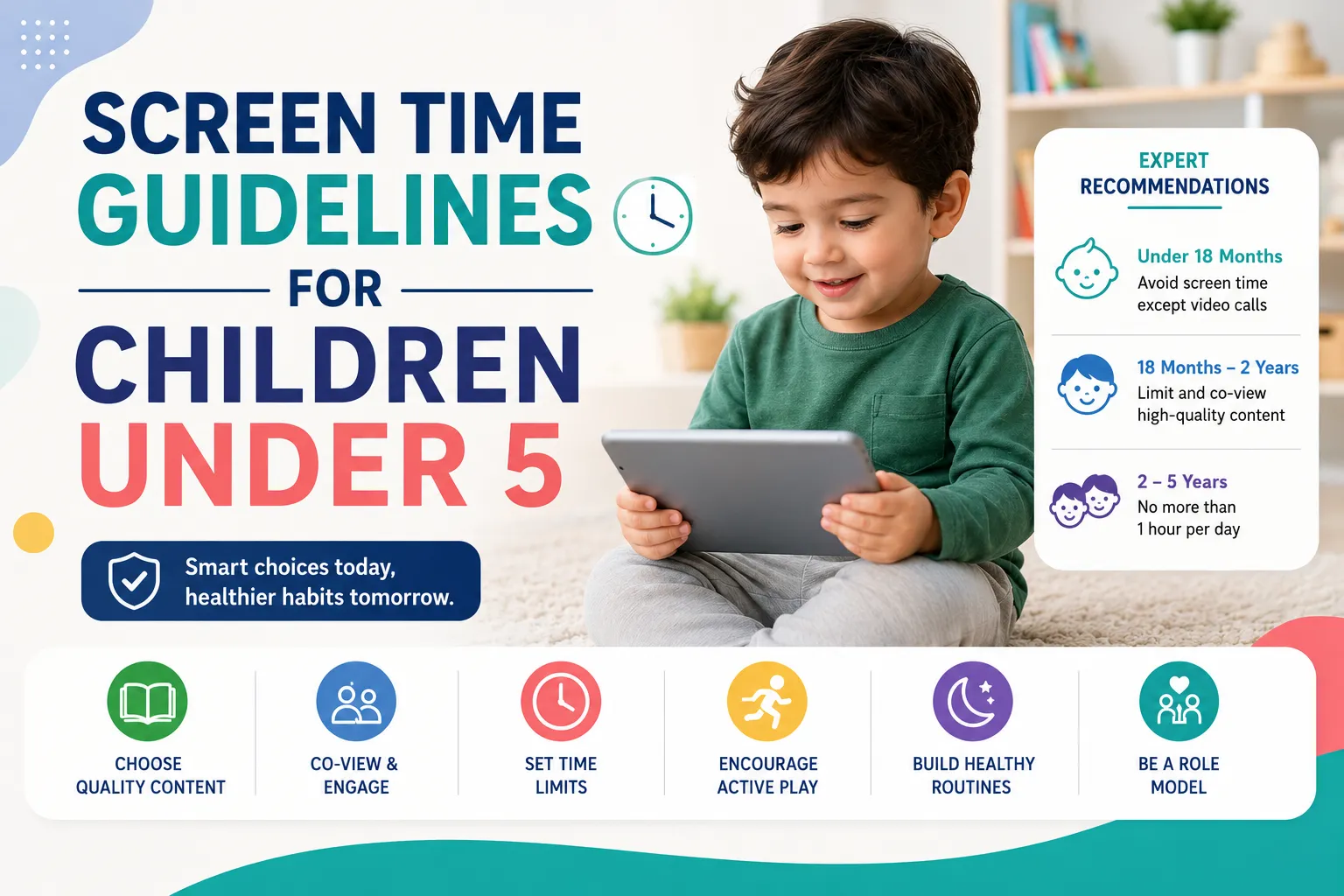
Wondering how much screen time is safe for your child? Discover expert guidelines, age-wise recommendations, and tips for healthy screen habits.




In today’s world, screens are everywhere. From video calls with grandparents in another city to nursery rhymes on YouTube during traffic jams, digital devices have quietly become an integral part of modern parenting. However, somewhere between ‘just one cartoon’ and full-blown negotiations involving all the adults in the house and a screaming toddler, all parents have asked themselves, ‘how much screen time is too much’?
While screens can occasionally rescue a parent trying to finish some work or keep a child occupied for a while, research consistently shows that early childhood development still depends far more on human interaction than on glowing rectangles.
The challenge, therefore, is on using screens wisely.
Experts Recommendations on screen time for kids
Broad recommendations of the World Health Organization (WHO) and the American Academy of Paediatrics state that children:
-
Below 2 years: Ideally avoid screen time altogether, except for supervised video calls with family.
-
2 to 5 years: Limit screen time to about one hour per day of high-quality content, preferably watched with an adult.
That may sound ambitious in an age where toddlers can unlock smartphones before an adult can count from 1-10, but the science behind these recommendations is quite compelling.
What is particularly noteworthy is that these recommendations do not focus on screen hours – instead on what screens may be replacing:
-
physical movement,
-
face-to-face interaction,
-
sleep,
-
free play,
-
and emotional connection.
In other words, the concern is not merely the presence of screens, but the absence of everything else.
Is screen time harmful? - Excessive Screen Time Effects
A child’s brain develops rapidly during the first five years of life. Neural connections responsible for language, emotional regulation, attention span, and social skills are shaped through real-world experiences — talking, touching, playing, observing faces, and exploring environments.
Screens with their passive viewing replace these experiences.
Several behavioural science studies have linked excessive screen exposure in early childhood with:
-
Delayed speech and language development
-
Reduced attention span
-
Sleep disturbances
-
Increased irritability
-
Lower physical activity levels
-
Reduced outdoor exposure
-
Unhealthy snacking habits
-
Eyesight and posture related strain
-
Difficulty with emotional self-regulation, among other challenges
In simpler terms: a child learns more from stacking steel dabba lids in the kitchen than from watching animated fruits singing the alphabet for three hours.
Quality of Content
Not all screen time is equally harmful. A video call with grandparents, where the child interacts socially, is very different from endless videos designed to hold attention. Experts increasingly recommend treating digital content the same way we treat food labels: not everything marketed to children is necessarily good for them in large quantities.
Research suggests that co-viewing — when parents watch and discuss content with children — can significantly improve learning outcomes. Children under five learn best through responsive interaction. For example, if a child watches a video about animals and the parent says, “That’s an elephant! We saw one at the zoo, remember?” the brain processes the information more actively. A child watching a video about colours learns far more when a parent points to objects around the house and continues the activity offline.
A useful question for parents is not simply, ‘is this educational?’ but rather: ‘does this content encourage curiosity, interaction, and real-world learning — or is it merely keeping my child occupied?’
Sometimes, the difference is subtle. But over time, it matters considerably.
This distinction is particularly relevant in urban Indian households where educational apps are increasingly marketed as brain development tools. Children under five do not need constant stimulation. They need opportunities to explore the world around them at their own pace.
Parenting Reality
Most urban families live in compact apartments with limited outdoor access. Many households are nuclear with both parents balancing demanding jobs while trying to raise children. Extended family support may be limited. Urban commutes are long and a work-from-home culture possibly blurs the screen boundaries further.
In such situations, screens become practical tools. And that is important to acknowledge reality without guilt.
Behavioural science experts increasingly caution against ‘all-or-nothing’ parenting. Research shows that parental stress and guilt can themselves affect family well-being. A calm parent using screens thoughtfully is often better than an exhausted parent trying to maintain impossible standards.
The goal is balance, not perfection.
Practical Screen time Guidelines for children
Instead of focusing only on screen limits, families can build healthier digital habits through structure and consistency.
1. Screen-Free Rituals
Certain moments should remain screen-free:
-
During meals
-
Before bedtime
-
Family conversations
-
Outdoor outings
These routines strengthen emotional connection and communication skills.
Children also learn emotional cues through real human interaction — facial expressions, tone, waiting, sharing, repairing conflicts. Provide opportunities for this emotional practice through conversations and dialogues during screen free time.
2. Prioritise Sleep
Studies consistently show that screen exposure before sleep affects melatonin production and sleep quality in children. Blue light and stimulating content can make it harder for young brains to settle down.
Avoid screens at least one hour before bedtime and replace them with stories, music, or quiet play.
3. Encourage Boredom
Modern parenting sometimes treats boredom like a medical emergency, whereas boredom supports creativity and independent thinking.
Children who are occasionally ‘left to figure out’ invent games, explore surroundings, and build imagination. Yes, this may occasionally involve emptying an entire drawer of plastic containers. Consider it cognitive development with side effects.
4. Model Healthy Behaviour
Children observe adults constantly. If parents check phones every few minutes, children naturally see screens as the centre of attention.
Behavioural scientists call this ‘social modelling’. In many cases, reducing adult screen dependency improves children’s habits more effectively than strict rules aimed only at the child.
5. Choose Interactive Content
If screens are used, prioritise:
-
Storytelling
-
Songs with participation
-
Movement-based content
-
Language-building activities
Avoid fast-paced, overstimulating videos designed primarily to maximise viewing time.
When To Be Concerned?
Reassessing digital habits maybe required if the following behaviours are noticed:
-
child becomes extremely distressed when screens are removed,
-
screen time regularly interferes with sleep,
-
meals become impossible without a device,
-
child loses interest in physical play,
-
communication and social interaction noticeably reduce.
These signs do not necessarily indicate ‘screen addiction,’ but may suggest an unhealthy dependency pattern worth addressing gradually.
Balancing Perspective
Technology is not the villain of modern parenting. Screens helped children attend online classes during the pandemic, connect with distant relatives, and access varied educational resources unimaginable a generation ago.
The real concern is not whether children watch screens occasionally. It is whether screens begin replacing the experiences that help children develop emotionally, socially, and physically.
Healthy screen habits are less about strict prohibition and more about intentional parenting. Flexibility and informed decision making can go a long way.
And if on someday your child watched a show while you ate a quick meal in peace at the end of the tiring day — that is probably okay too.
FAQs
1. How much screen time is recommended for children under 5?
Screen time recommendations vary by age. Children under 18 months should avoid screen media except for video calls. For children aged 2 to 5 years, experts recommend limiting screen time to no more than one hour per day of high-quality, educational content with parental supervision.
2. Is screen time harmful for children under 5?
Excessive screen time can affect sleep, physical activity, attention span, and social development. However, age-appropriate, educational content viewed in moderation and with parental involvement can support learning and communication skills.
3. What are the benefits of screen time for young children?
When used appropriately, screen time can help children learn new concepts, develop language skills, improve creativity, and access educational content. Interactive and age-appropriate programs often provide the most benefits.
4. What are the risks of too much screen time for toddlers and preschoolers?
Excessive screen use may lead to reduced physical activity, sleep disturbances, delayed language development, behavioral issues, and less face-to-face interaction with family members and peers.
5. What types of screen content are best for children under 5?
Educational, age-appropriate, and interactive content is generally recommended. Parents should choose high-quality programs that encourage learning, creativity, problem-solving, and positive social behaviors.
6. Should parents watch screens with their children?
Yes. Co-viewing helps parents explain content, answer questions, reinforce learning, and ensure children are engaging with appropriate material. Shared screen experiences are more beneficial than unsupervised viewing.
7. Can screen time affect a child's sleep?
Yes. Screen exposure, especially before bedtime, can interfere with sleep quality and duration. Experts recommend avoiding screens at least one hour before sleep and establishing a consistent bedtime routine.
8. How can parents reduce screen time for children under 5?
Parents can reduce screen time by encouraging outdoor play, reading books, creative activities, family interactions, and establishing clear screen-use rules and daily routines.
9. Is educational screen time different from entertainment screen time?
Educational screen time focuses on learning and skill development through age-appropriate content, while entertainment screen time is primarily for recreation. Educational content generally provides greater developmental value when used in moderation.
10. What are healthy alternatives to screen time for young children?
Healthy alternatives include outdoor play, storytelling, drawing, puzzles, music, imaginative play, arts and crafts, and interactive family activities that support physical, cognitive, and social development.
11. At what age can children start using digital devices?
Most health organizations recommend avoiding screen media for children younger than 18 months except for video chatting. After age 2, limited and supervised use of high-quality content is generally considered appropriate.
12. How does screen time affect child development?
Screen time can influence language, cognitive, emotional, and social development. Balanced screen use combined with physical activity, sleep, and real-world interactions supports healthier developmental outcomes.
13. What is the World Health Organization's screen time recommendation for children under 5?
The World Health Organization recommends no sedentary screen time for infants under 1 year, no more than one hour per day for children aged 2–4 years, and prioritizing physical activity, sleep, and interactive play.
14. Can video calls be beneficial for babies and toddlers?
Yes. Unlike passive screen viewing, video calls allow real-time interaction with family members and can support social connection, communication, and relationship-building.
15. How can families create a healthy screen time routine?
Families can create a healthy routine by setting daily limits, designating screen-free zones, encouraging active play, choosing educational content, and modeling responsible technology use.