
Social Skills Development in Preschool: A Parent's Complete Guide
Learn about social skills development in preschool, why social skills are important for preschoolers, signs of good social development in children, and practical ways to help your child make friends.




If you’ve ever watched a preschooler negotiate snack sharing, you know what conflict and diplomacy look like! Social skills development in preschool begins early, and it is serious business—wrapped in very cute packaging.
In India, children grow up in beautifully diverse family settings. Some are in bustling joint families where there is always someone to talk to, argue with, or hug, though they may not be of the same age group. Others are in nuclear families where playdates, school, and parks become important social spaces. In both cases, one thing remains the same—social skills for preschoolers don’t just ‘happen.’ They are gently built every day through experience, guidance, and a lot of patient repetition. And yes, sometimes it also includes learning that snatching a toy is not a long-term friendship strategy.
Let’s explore how social skills development in preschool supports social development in children and how parents can support them in practical everyday contexts.
What Social Skills Mean in Early Childhood
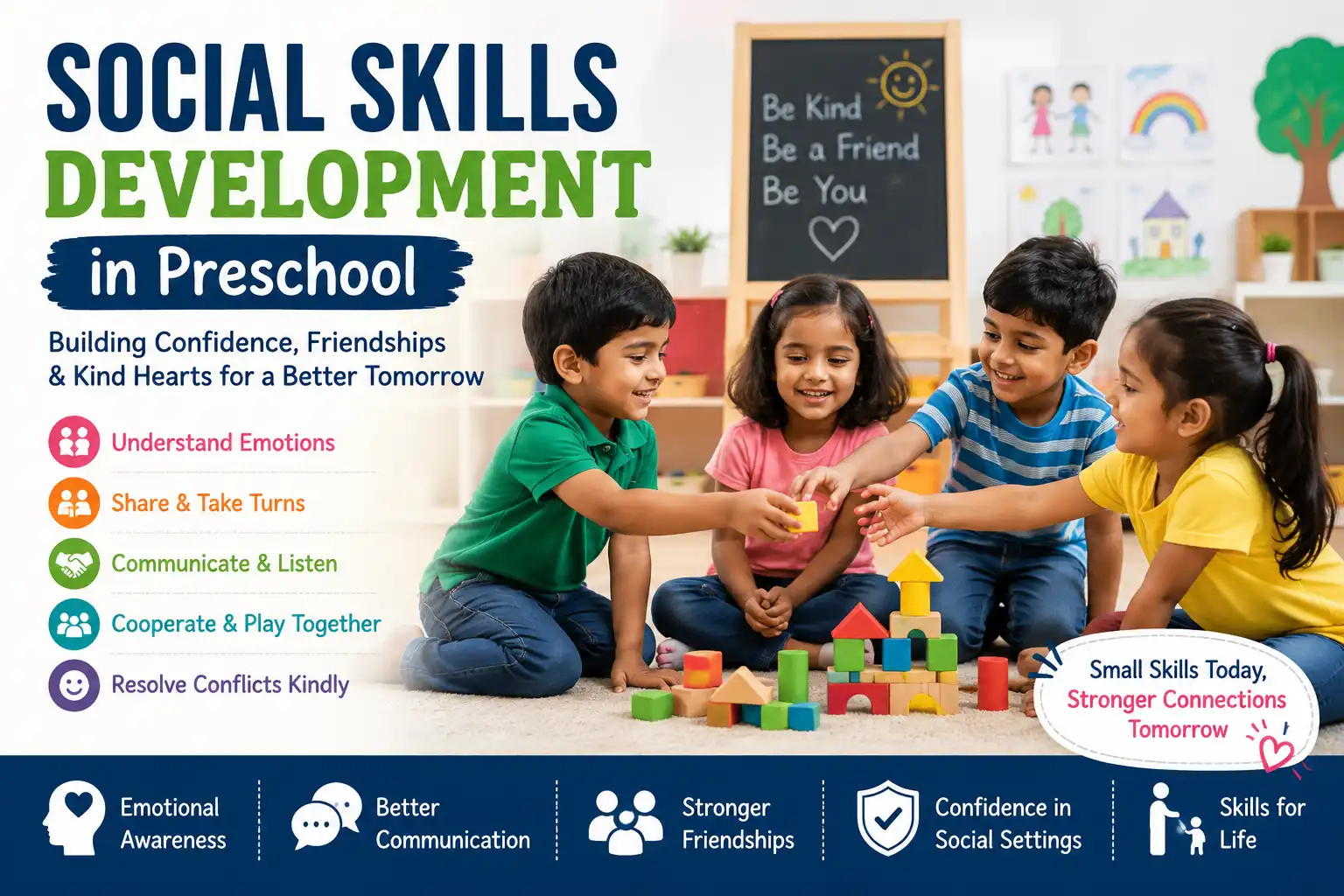
For preschoolers, social skills include a wide range of abilities such as:
- Sharing and taking turns
- Communicating needs and feelings
- Understanding others’ emotions
- Cooperating in group activities
- Following simple rules
- Building friendships
- Resolving small conflicts
These are the building blocks of social development in children and form the foundation of how children learn to live, play, and grow with others.
Emotional Awareness
Before children can understand others, they first need to understand themselves.
Preschoolers often experience big emotions—joy, anger, frustration, excitement—but don’t always have the words for them. Helping children name emotions is the first step toward healthy social interaction. Learning to cope when things don’t go their way helps children build emotional resilience and social maturity. Everyday moments are perfect teaching opportunities:
- “You look upset because your toy broke.”
- “I can see you’re excited for Nani’s visit!”
- “It’s okay to feel angry, but we don’t hit.”
Even a simple bedtime chat after a long day at school can become a powerful emotional learning moment and contribute positively to social development in children.
Communication Skills
Social skills grow when children learn both speaking and listening.
Many preschoolers are naturally expressive—sometimes very expressive. But learning to listen is equally important. Parents can encourage this through:
- Story time discussions (asking “What happened next?”)
- Simple conversation routines during meals
- Encouraging eye contact and turn-taking in speech
In joint families, children often learn communication quickly because there is always an audience—grandparents, cousins, uncles, aunties, and conversations are continuous.
In nuclear families, parents may need to consciously create more conversation moments, especially after work hours.
Sharing and Turn-Taking
Sharing is not a natural instinct for most preschoolers. A toy car in a child’s hand is not just a toy—it is a deeply personal possession with emotional value and possibly a legal claim. Sharing must be taught gradually and strategically:
- Use timers: “You play for 5 minutes, then your turn ends.”
- Model sharing at home: “I’ll share my snack with you.”
- Praise effort, not perfection: “You gave your brother a turn—that was kind.”
In joint families, children may often learn sharing early simply because there are more people. For nuclear families, playdates and park visits become important practice grounds. Even in digital interactions, like video calls with grandparents, help children learn greeting, turn-taking, and conversation skills.
Learning simple boundaries like asking before taking something or respecting when someone says “no” helps children build respectful relationships.
Cooperation and Group Play
Preschoolers learn cooperation through play, not lectures. Building blocks together, pretend play, and group activities teach:
- Working towards a common goal
- Negotiating roles (“You be the doctor; I’ll be the patient”)
- Accepting ideas from others
At the preschool stage, friendships are often built through shared play rather than deep conversations. A child may call someone their ‘best friend’ simply because they both love the slide or sit at the same table. Feeling part of a group—like a classroom, dance group, or play circle—helps children develop a sense of belonging and shared identity.
At home, festival preparations or helping in simple kitchen tasks can become opportunities to model teamwork in a natural way.
Conflict Resolution
Conflicts among preschoolers are normal and frequent. The goal is not to eliminate conflict but to teach children how to handle it.
Instead of immediately solving problems for them, parents can guide with:
- “What can you say instead of pushing?”
- “How can we solve this together?”
- “Let’s find a fair solution.”
In joint families, children often experience more conflicts—but also more opportunities to resolve them. In nuclear families, parents may need to intentionally introduce group settings so children can practise these skills. Irrespective of the type of family, when adults around them model healthy conflict resolution, children pick it up more easily.
Empathy
Empathy is one of the most important social skills and develops gradually.
Adults can build empathy by:
- Pointing out emotions in others: “Look, your friend is sad.”
- Asking reflective questions: “How do you think she felt?”
- Encouraging kindness actions: helping, comforting, sharing
Storytelling traditions work powerfully here. Stories from age-appropriate books help children understand consequences and emotions without feeling judged.
Confidence in Social Settings
A socially skilled child is not necessarily the most talkative one—but the one who feels comfortable in interactions. Confidence can be built by:
- Allowing children to greet guests
- Encouraging small responsibilities (“Give this to Mom.”)
- Praising attempts at interaction
While many children may be very confident at home, they may need encouragement to interact outside in unfamiliar settings. Preschoolers gradually learn to adapt to new environments—whether it’s a new classroom, a birthday party, or a visit to relatives. Comfortable and graded exposures build social confidence and flexibility.
Parents often ask, "How can I help my child make friends?" The answer lies in creating regular opportunities for children to play with peers, modelling kind behaviour, encouraging conversation, and allowing children to solve small social challenges independently with gentle guidance.
Why Are Social Skills Important for Preschoolers?
Why are social skills important for preschoolers? Strong social skills help children communicate effectively, build friendships, cooperate with others, resolve conflicts peacefully, and develop confidence. These early experiences also support emotional well-being, school readiness, and long-term success in relationships and learning.
What Social Skills Should a 4 Year Old Have?
Many parents wonder, "What social skills should a 4 year old have?" While every child develops at their own pace, most four-year-olds are beginning to:
- Share and take turns with gentle reminders
- Express their feelings using words
- Follow simple group rules
- Play cooperatively with other children
- Show empathy when someone is upset
- Solve minor disagreements with adult support
- Build and maintain simple friendships
These milestones are important indicators of healthy social development in children.
Signs of Good Social Development in Children
Some common signs of good social development in children include:
- Enjoying playing with other children
- Taking turns during games and activities
- Showing empathy and kindness
- Communicating needs appropriately
- Following simple social rules
- Cooperating in group settings
- Developing confidence in new social situations
Remember that every child develops differently, and progress is gradual rather than perfect.
Different Settings, Same Intent
Whether in a joint or nuclear family or at school, the goal remains the same—raising kind, confident, and socially aware children. Social skills development in preschool happens through everyday moments: sharing, taking turns, resolving conflicts, showing respect, and building friendships. When freedom is balanced with gentle guidance and experiences are reflected upon without judgement, children build the confidence, empathy, and communication skills needed to thrive in their world.