
Table of 2 | 2 Times Table Chart, Multiplication Table of Two & Practice for Kids
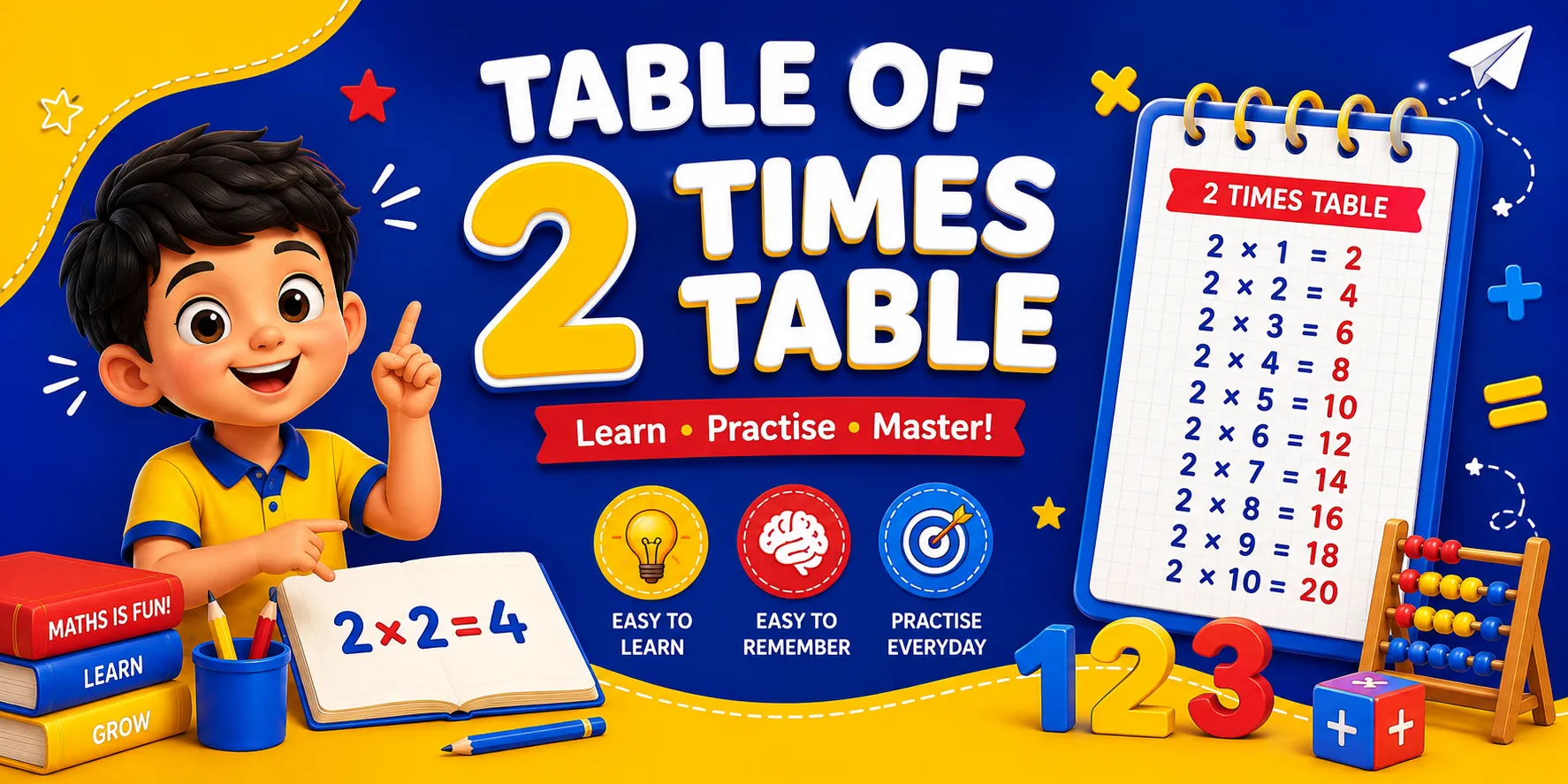
Learn the Table of 2 with an easy 2 times table chart, multiplication tricks, solved examples, word problems, and practice questions. A fun and engaging guide for kids to master multiplication.




Learning the Table of 2 is one of the first steps in mastering multiplication. It helps children build a strong foundation in mathematics and makes everyday calculations quicker and easier. Since the 2 times table follows a simple pattern, it is one of the easiest multiplication tables for young learners to remember.
In this guide, children will learn the multiplication table of 2, discover simple tricks to memorize it, solve fun examples, and practice questions to improve their maths skills.
What is the Table of 2?
The Table of 2 consists of the multiples of 2 obtained by multiplying 2 by whole numbers. It can also be understood as adding the number 2 repeatedly.
For example:
-
2 × 1 = 2
-
2 × 2 = 4
-
2 × 3 = 6
Knowing the table of 2 helps children solve multiplication, division, and mental maths questions more confidently.
2 Times Table Chart
| Multiplication | Result |
|---|---|
| 2 × 1 | 2 |
| 2 × 2 | 4 |
| 2 × 3 | 6 |
| 2 × 4 | 8 |
| 2 × 5 | 10 |
| 2 × 6 | 12 |
| 2 × 7 | 14 |
| 2 × 8 | 16 |
| 2 × 9 | 18 |
| 2 × 10 | 20 |
| 2 × 11 | 22 |
| 2 × 12 | 24 |
| 2 × 13 | 26 |
| 2 × 14 | 28 |
| 2 × 15 | 30 |
| 2 × 16 | 32 |
| 2 × 17 | 34 |
| 2 × 18 | 36 |
| 2 × 19 | 38 |
| 2 × 20 | 40 |
Table of 2 from 1 to 10
-
2 × 1 = 2
-
2 × 2 = 4
-
2 × 3 = 6
-
2 × 4 = 8
-
2 × 5 = 10
-
2 × 6 = 12
-
2 × 7 = 14
-
2 × 8 = 16
-
2 × 9 = 18
-
2 × 10 = 20
Easy Ways to Learn the 2 Times Table
1. Count by Twos
Skip counting by 2 is the easiest way to learn this table.
2, 4, 6, 8, 10, 12, 14, 16, 18, 20...
2. Repeated Addition
Add 2 each time to get the next answer.
Example:
2 → 4 → 6 → 8 → 10
3. Find Even Numbers
Every multiple in the table of 2 is an even number.
Examples: 2, 4, 6, 8, 10, 12...
Recognizing this pattern makes memorization easier.
4. Practice with Everyday Objects
Use toys, pencils, or blocks and group them into pairs to understand multiplication by 2 in a fun and practical way.
Pattern in the Table of 2
The table of 2 has a simple and predictable pattern:
-
Every new number increases by 2.
-
All answers are even numbers.
-
The ones digit follows a repeating sequence: 2, 4, 6, 8, 0.
Recognizing these patterns helps children remember the table more easily.
Solved Examples
Example 1
Find 2 × 9.
Solution:
2 × 9 = 18
Example 2
There are 2 balloons in each packet. How many balloons are there in 8 packets?
Solution:
2 × 8 = 16
Answer: 16 balloons
Example 3
A gardener plants 2 flowers in each pot. If there are 12 pots, how many flowers are planted?
Solution:
2 × 12 = 24
Answer: 24 flowers
Practice Questions
Fill in the blanks.
-
2 × 5 = _____
-
2 × 11 = _____
-
2 × 16 = _____
-
2 × 19 = _____
-
2 × 20 = _____
Answers
-
10
-
22
-
32
-
38
-
40
Word Problems
1.
Each bicycle has 2 wheels. How many wheels do 7 bicycles have?
Answer: 14 wheels
2.
A child has 2 crayons in each box. If there are 9 boxes, how many crayons are there?
Answer: 18 crayons
3.
There are 2 birds sitting on each tree. If there are 15 trees, how many birds are there?
Answer: 30 birds
Benefits of Learning the Table of 2
Learning the 2 times table helps children:
-
Build a strong foundation in multiplication.
-
Improve mental maths and calculation speed.
-
Understand the concept of even numbers.
-
Solve multiplication and division questions more confidently.
-
Prepare for learning higher multiplication tables.
Tips for Parents
Parents can make learning the table of 2 enjoyable by:
-
Practising skip counting every day.
-
Using flashcards and number charts.
-
Encouraging children to count objects in pairs.
-
Playing multiplication games and quizzes.
-
Revising the table regularly for better retention.
Conclusion
The Table of 2 is one of the most important multiplication tables for young learners. Since it follows an easy pattern, children can master it with regular practice and simple activities. Encouraging daily revision, solving fun word problems, and applying multiplication in everyday life will help children build confidence and develop strong mathematical skills.

FAQs
What is the table of 2?
Why should children learn the 2 times table first?
What is the easiest way to remember the table of 2?
What is 2 multiplied by 15?
How often should children practise the table of 2?
What is the table of 2?
What is the easiest way to remember the table of 2?
How often should children practise the table of 2?
Why should children learn the 2 times table first?
What is 2 multiplied by 15?