
Easy Science Experiments for Kids: 10 Fun STEM Activities at Home
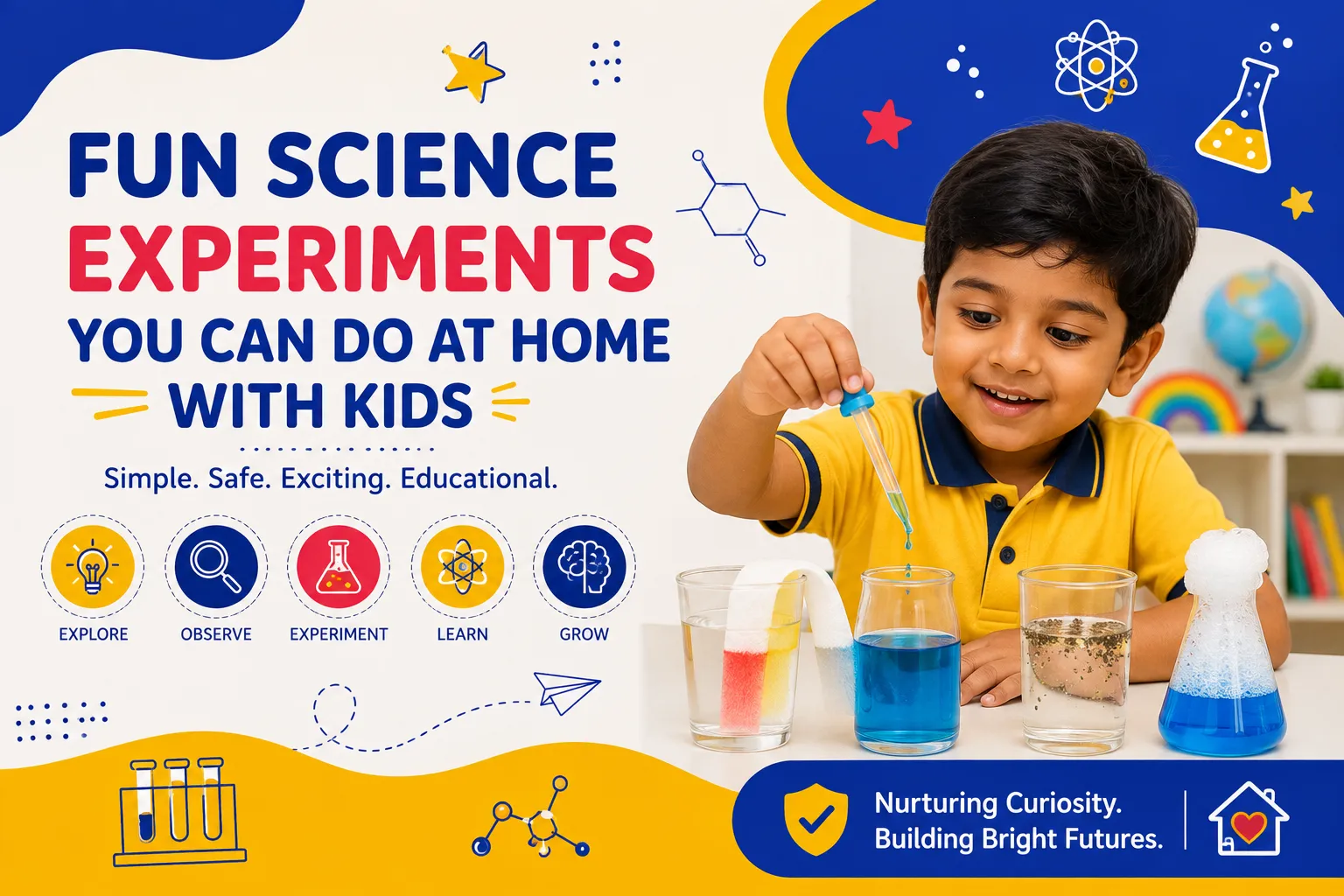
Discover 10 easy science experiments for kids using everyday household items. Build curiosity, STEM skills, critical thinking, creativity, and school readiness through fun hands-on learning.




Simple science experiments help toddlers and preschoolers explore how the world works through observation, prediction, investigation, and discovery. Using everyday household materials, children develop scientific thinking, curiosity, creativity, and early STEM skills while enjoying hands-on learning with parents.
Young children are naturally curious about the world around them. They love asking questions, exploring new things, and discovering how everyday objects work. Simple science experiments at home are a wonderful way to nurture this curiosity while making learning fun.
For preschoolers, science is not about complicated theories or laboratory equipment. It is about observing, touching, mixing, comparing, and asking questions.
These early science activities encourage children to think like little scientists by observing, asking questions, making predictions, testing ideas, and talking about what they discover.
Simple science activities encourage children to:
- Observe and ask questions.
- Think logically and make predictions.
- Develop curiosity and creativity.
- Build vocabulary through new experiences.
- Strengthen fine motor skills.
- Improve concentration and confidence.
These hands-on experiences help children develop observation skills, problem-solving abilities, language, and early thinking skills.
Science experiments also introduce foundational STEM (Science, Technology, Engineering and Mathematics) concepts in an age-appropriate and enjoyable way, helping children connect classroom learning with everyday experiences.
The best part is that many exciting science experiments can be done using everyday items found in most Indian homes. With a little supervision, parents can turn ordinary moments into memorable learning experiences.
Why Hands-on Science Matters
Young children learn best when they actively explore rather than simply observe. Hands-on science activities strengthen curiosity, encourage inquiry-based learning, improve communication skills, and help children understand cause-and-effect relationships through real experiences.
Let us explore a few easy to do experiments. Most of these experiments take just 10–15 minutes and use materials commonly found in Indian kitchens and homes, making them easy to try without any special preparation.
1. Walking Water
Materials Needed
- 3 glasses
- Water
- Red and yellow food colour
- Paper towels
Steps
Fill the two outer glasses halfway with water. Add red colour to one glass and yellow colour to the other. Leave the middle glass empty. Fold paper towels into strips and place one end in the coloured water and the other end in the empty glass. Wait for a few hours and watch the coloured water slowly move into the middle glass.
Key Concepts Learnt
The paper towel soaks up the coloured water and slowly carries it from one glass to the other. When the two colours meet in the middle, they mix to make a new colour.
Encourage children to predict what colour might appear before the experiment begins and compare their prediction with the final result.
2. Sink or Float
Materials Needed
- A bucket or large bowl of water
- Spoon
- Leaf
- Stone
- Plastic toy
- Coin
- Bottle cap
Steps
Ask your child to guess whether each object will sink or float before placing it in the water. Drop one object at a time and observe what happens.
Key Concepts Learnt
Some objects float on top of the water while others sink to the bottom - different materials behave differently in water.
Ask children why they think some objects float while others sink to encourage observation and reasoning rather than simply identifying the correct answer.
3. Magic Colour Mixing
Materials Needed
- Three transparent bowls
- Water
- Red, blue and yellow food colours
- Spoon
Steps
Fill each bowl with water and add one primary colour. Mix small amounts from two bowls into another empty bowl to discover new colours.
Key Concepts Learnt
Mixing two colours can create a completely new colour, or even a different shade of the same colour – combining different things can create something totally new.
This activity also strengthens colour recognition, observation skills, and creative thinking through playful exploration.
4. Dancing Raisins
Materials Needed
- A transparent glass
- Soda water
- A few raisins
Steps
Fill the glass with soda water and drop in the raisins. Watch as they rise to the top and then slowly sink again.
Key Concepts Learnt
Tiny bubbles from the soda stick to the raisins and lift them to the top. When the bubbles burst, the raisins sink down again, making them look like they are dancing.
Children often enjoy repeating this experiment with different small objects to compare what happens, encouraging scientific investigation.
5. Growing Rainbow with Paper Towels
Materials Needed
- Paper towel
- Sketch pens
- Two glasses of water
Steps
Draw thick rainbow stripes on both ends of a folded paper towel. Place each coloured end into separate glasses filled with water. Watch as the colours spread towards the centre.
Key Concepts Learnt
The paper towel soaks up the water and carries the colours towards the middle. As the colours spread, they meet and create a beautiful rainbow.
6. Ice Cube Rescue
Materials Needed
- Ice cubes
- Salt
- Small bowl
- Spoon
Steps
Place ice cubes in a bowl and sprinkle a little salt over one cube while leaving another untouched. Observe which one melts faster.
Key Concepts Learnt
Salt helps the ice melt faster than ice without salt left on its own - small changes can make the same things happen differently.
Children can compare different amounts of salt and observe whether the melting speed changes.
7. Balloon with Static Electricity
Materials Needed
- Balloon
- Small paper pieces
Steps
Blow up the balloon and rub it on your child's hair or a woollen cloth. Bring it close to the paper pieces without touching them and watch them jump towards the balloon.
Key Concepts Learnt
Rubbing the balloon creates a tiny kind of energy called static electricity. This energy can pull light paper pieces towards the balloon without even touching them.
Experiment with different lightweight materials such as tissue paper or tiny fabric pieces to observe similar effects.
8. Homemade Rain Cloud
Materials Needed
- Transparent glass
- Water
- Shaving foam
- Blue food colour
- Dropper
Steps
Fill the glass with water and add a layer of shaving foam on top. Slowly drop blue food colouring onto the foam and watch it fall through like rain.
Key Concepts Learnt
The shaving foam acts like a cloud holding tiny drops of coloured water. When the cloud becomes too full, the colour falls through just like rain from the clouds.
This activity provides an excellent opportunity to discuss weather, clouds, rainfall, and the water cycle using simple language.
9. Shadow Hunt
Materials Needed
- Torch
- Favourite toys
- Wall
Steps
Switch off the lights and shine the torch towards different toys to create shadows. Move the torch closer and farther to see how the shadows change.
Key Concepts Learnt
A shadow is made when an object blocks the light. Observe how the moving torch changes the size and shape of the shadow.
Invite children to explore how shadows change during different times of the day using natural sunlight.
10. Pepper and Soap Magic
Materials Needed
- A shallow plate
- Water
- Ground black pepper
- Liquid dish soap
- Cotton bud (ear bud)
Steps
Fill the plate with water and sprinkle a little black pepper over the surface. Dip one end of a cotton bud into a drop of liquid dish soap. Gently touch the soapy end to the middle of the water and watch the pepper quickly move away.
Key Concepts Learnt
Soap changes the way water behaves, making the pepper move away from it – adding something new can change the way things happen in surprising ways!
Children quickly discover that small changes can produce surprising results, encouraging curiosity and experimentation.
Tips for Safe and Enjoyable Science Activities at Home
Always supervise children during experiments and use only safe, age-appropriate household materials.
Allow children to make guesses before beginning and encourage them to describe what they observe. Ask questions like "What do you think will happen next?" or "Why do you think that happened?"
Allow children to repeat experiments, change one variable at a time, and compare different outcomes. Repetition helps strengthen observation, reasoning, and scientific thinking.
There is no need to explain every scientific concept in detail. At this age, the goal is to encourage curiosity and exploration. Keep experiments simple and fun.
Praise curiosity, effort, and thoughtful questions rather than focusing only on getting the 'right' answer. Scientific learning begins with exploration.
There is always something new to explore and experiment with ideas in books and trusted educational websites.
Making Science Part of Everyday Learning
Science learning does not have to be limited to planned activities. Children can observe plants growing on the balcony, notice how clothes dry in the sun, watch ice melt in a glass, or see how dough changes while making rotis. Using everyday materials and experiences, preschoolers can discover exciting ideas about colours, water, air, light, weather, and nature!
Cooking, gardening, nature walks, watering plants, sorting household objects, observing insects, and watching the weather all provide valuable opportunities for everyday scientific learning.
Final Thoughts
Simple science experiments create joyful opportunities for children and parents to learn together.
By encouraging children to ask questions and explore the world around them, parents help build confidence, curiosity, and a lifelong love for learning.
Most importantly, these playful experiments show children that science is not limited to classrooms or laboratories. It is part of everyday life, waiting to be explored through curiosity, observation, and imagination.

FAQs
What are the benefits of science experiments for preschoolers?
What are some easy science experiments children can do at home?
How do science experiments support early childhood development?
Are science experiments safe for toddlers and preschoolers?
What STEM skills do children develop through science experiments?
How often should children do science activities?
Why is inquiry-based learning important in early childhood?
How can parents encourage scientific thinking at home?
What are the benefits of science experiments for preschoolers?
How do science experiments support early childhood development?
What STEM skills do children develop through science experiments?
Why is inquiry-based learning important in early childhood?
What are some easy science experiments children can do at home?
Are science experiments safe for toddlers and preschoolers?
How often should children do science activities?
How can parents encourage scientific thinking at home?