

How to Help a Shy Child Feel Confident at School: 8 Tips
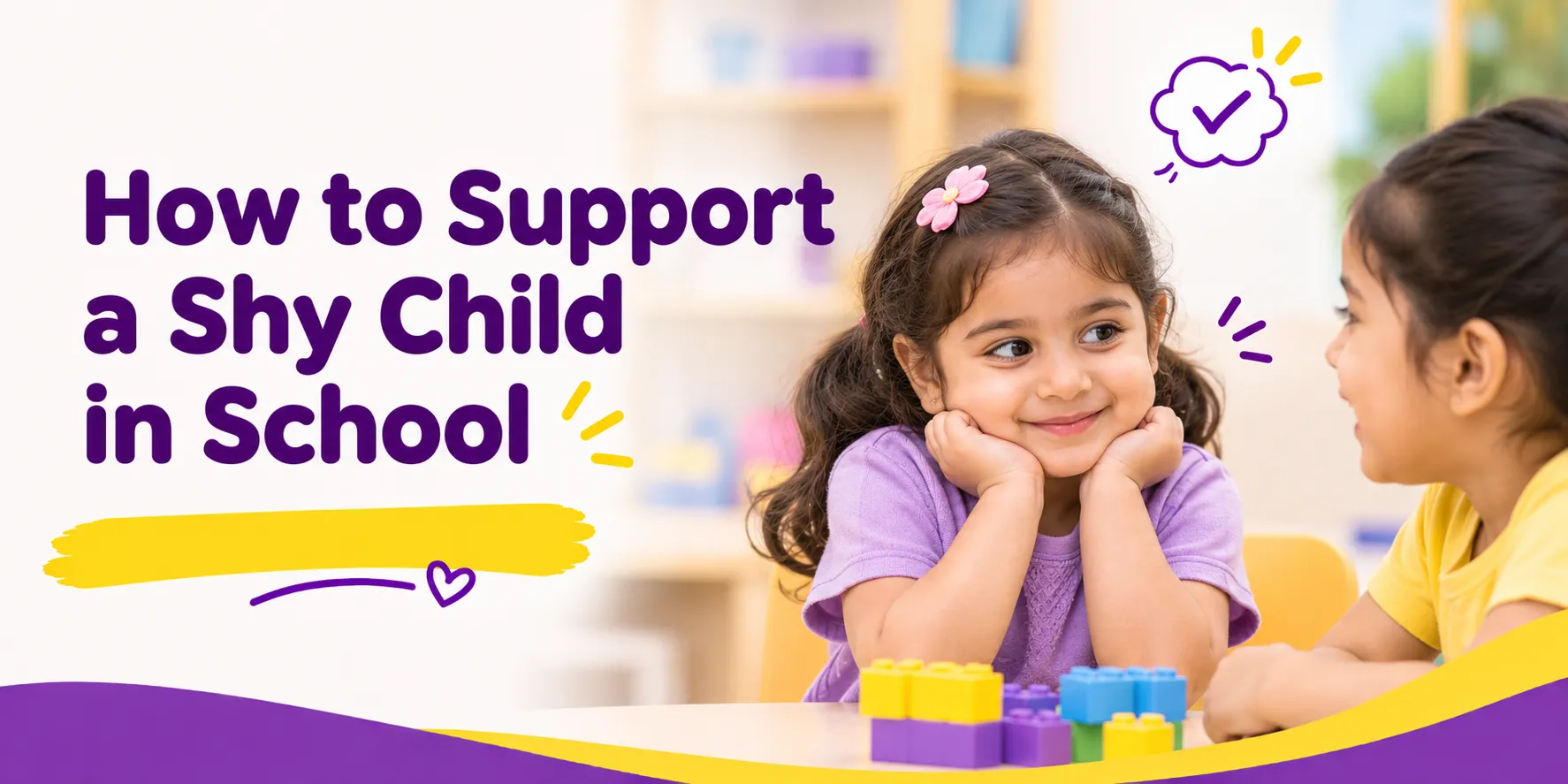
Is your child shy at school? Discover 8 practical ways parents and teachers can build social confidence and help preschoolers feel comfortable.




Every child enters a classroom with a unique personality. Some children eagerly greet their teachers, make friends quickly, and participate in every activity. Others prefer to observe, understand their surroundings, and become comfortable before they begin to express themselves.
Supporting a shy child in school starts with giving them time to feel comfortable, creating opportunities for small social interactions, and recognising their efforts without putting them under pressure. Parents and teachers can work together to help children gradually build social confidence while respecting their individual personalities.
For preschoolers, this is completely natural. At this age, children are still making sense of their environment, understanding their emotions, and learning how to interact with people outside their immediate family. Their personalities and social behaviours are also still developing. A child who appears shy today may gradually become more expressive as they gain familiarity, confidence, and a sense of security.
Therefore, rather than viewing shyness as something that needs to be “fixed,” parents and educators can focus on understanding what the child may be feeling and provide the right encouragement to help them participate at their own pace.
What Does Shyness Look Like in Preschoolers?
Shyness can look different for every child. A shy child may hesitate to speak in a group, take time to interact with unfamiliar people, stay close to a familiar adult, or prefer observing an activity before joining in.
This does not necessarily mean that the child lacks confidence or social skills. Sometimes, the child simply needs more time to process a new environment or situation.
Think about a preschooler's first few days at school. There are new faces, new routines, new sounds, new expectations, and an entirely new social environment. While one child may immediately start exploring the classroom, another may first want to watch what everyone else is doing. Both are valid ways of adjusting to a new experience.
Some children naturally express themselves freely, while others need a motivating factor—a familiar face, an interesting activity, a reassuring teacher, or a little encouragement—to feel comfortable enough to participate.
Some children may be comfortable talking and playing at home but become quieter in unfamiliar surroundings. Others may need more time to join conversations, approach classmates or participate in group activities. Observing these patterns across different situations can help adults understand what makes a child feel comfortable.
8 Ways to Help a Shy Child Feel More Confident at School
The goal should not be to change the child's personality. Instead, adults can create opportunities that help the child feel secure enough to communicate, participate, and build relationships.
1. Avoid Labelling your Child as “Shy”
Repeatedly saying, “She is very shy” or “He doesn't talk to anyone” can unintentionally make shyness feel like a fixed part of the child's identity.
Instead, describe what is happening in the moment.
For example, you could say, “She takes a little time to become comfortable in a new place,” or “He likes to observe before joining an activity.”
This simple change in language leaves room for the child to grow and respond differently in different situations.
2. Give your Child Time to Warm Up
Not every child is ready to participate immediately.
When entering a new classroom, meeting new people, or joining a group activity, allow the child some time to observe. Avoid repeatedly asking, “Why aren't you talking?” or insisting that they join the group immediately.
A little patience can make a big difference. Once the environment begins to feel predictable and safe, the child may naturally become more willing to participate.
3. Encourage Small Social Experiences
A large group can sometimes feel overwhelming to a child who is still building social confidence.
Begin with smaller interactions. Encourage the child to play with one classmate, participate in an activity with a familiar teacher, or answer a simple question before expecting them to speak in front of the whole class.
Small successful experiences can gradually prepare children for larger social situations.
4. Use Play based Activities to Encourage Interactions
Children often communicate more freely when they are engaged in something they genuinely enjoy.
Drawing, storytelling, music, pretend play, puzzles, building blocks, outdoor games, or role-play can become natural opportunities for interaction.
For example, a child who rarely speaks during a group discussion may enthusiastically explain the tower they have built with blocks. That moment of expression can become a bridge to further communication.
Drawing, storytelling, music, pretend play, puzzles, building blocks, outdoor games, or role-play can become natural opportunities for interaction. Through play-based learning at Kidzee, children also get opportunities to explore, express themselves and learn through engaging experiences.
5. Prepare your Child for New Social Situations
Knowing what to expect can help make unfamiliar situations feel more manageable.
Before the first day of school, a class performance, a school event, or even meeting a new teacher, parents can talk about what is likely to happen.
s can also help. At home, practise saying “Hello,” asking another child to play, responding when the teacher asks a question, or introducing oneself.
The purpose is not to make the child memorise responses but to make the situation feel more familiar.
6. Celebrate Small Steps Towards Confidence
For a naturally reserved child, raising a hand once, greeting a classmate, joining a group activity, or speaking to the teacher may be a meaningful achievement.
Notice these efforts.
Instead of saying, “See, there was nothing to be shy about,” try saying, “I noticed you spoke to your teacher today. You gave it a try even though it was new.”
Such encouragement helps children recognise their own progress without making them feel that their natural temperament is wrong.
A supportive preschool environment can make a meaningful difference in a child's early years. At Kidzee, the focus on holistic early childhood development recognises the importance of nurturing each child's unique potential.
7. Avoid Comparing Your Child with Others
Statements such as “Look how confidently your friend speaks” or “Why can't you participate like the other children?” can create unnecessary pressure.
Children develop socially and emotionally at different rates. The meaningful comparison is not between one child and another—it is between where the child was earlier and the progress they are making now.
8. Work Together with Your Child’s Teacher
Parents may see a very talkative child at home while teachers see a quiet child at school—or the opposite.
Regular communication between parents and teachers helps both understand the child's behaviour across different environments.
Teachers can share situations in which the child appears comfortable and engaged, while parents can share the child's interests, preferred activities, and ways of communicating. Together, they can create consistent opportunities for the child to participate without unnecessary pressure.
When Should Parents Be Concerned About Shyness?
Being quiet or taking time to adjust does not automatically indicate a concern. However, parents may want to speak with their child's teacher or a qualified child development professional if their child consistently struggles to communicate their basic needs, experiences significant distress in social situations, avoids activities they previously enjoyed, or finds everyday interactions difficult across different settings.
It is important to understand the child's individual circumstances rather than assume that shyness alone indicates an underlying difficulty. Early conversations with the right professionals can help parents understand what support, if any, may be useful.
Confidence Grows Through Connection
During the preschool years, children are building the foundations of communication, relationships, independence, and emotional understanding. They do not all develop these abilities in exactly the same way or at the same pace.
A child who watches quietly from the side of the classroom may simply be taking time to understand the environment before stepping in.
What such children often need most is not pressure to “stop being shy,” but patient encouragement, opportunities to participate, and adults who make them feel accepted and secure.
With supportive parents, understanding teachers, and positive experiences at school, children can gradually learn to express themselves with greater confidence—while still being true to their individual personalities.
A supportive preschool environment can also give children opportunities to build relationships, express themselves and participate in activities at their own pace. Through guided interactions, group play, storytelling and collaborative experiences, children can gradually become more comfortable communicating with teachers and classmates.
Remember: The aim is not to turn every quiet child into the loudest voice in the classroom. It is to help every child feel comfortable enough to let their own voice be heard

FAQs
How can I help my shy child make friends at school?
Is it normal for a child to be shy at preschool?
Why is my child talkative at home but quiet at school?
How can teachers encourage shy children to participate in class?
How can I help my shy child make friends at school?
Why is my child talkative at home but quiet at school?
Is it normal for a child to be shy at preschool?
How can teachers encourage shy children to participate in class?