
Benefits of Puzzles for Kids: How Puzzles Boost Brain Development in Preschoolers
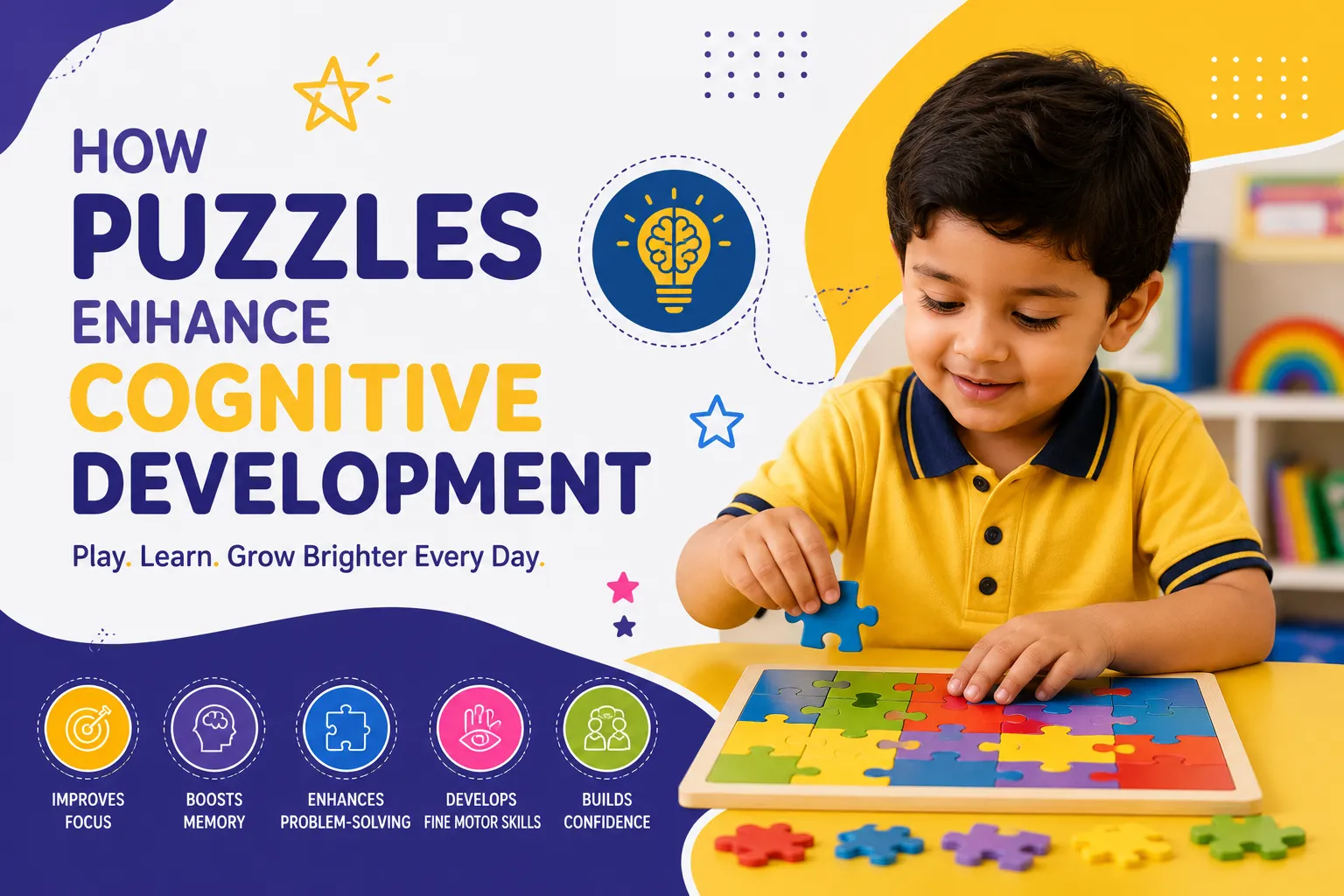
Discover how puzzles improve cognitive development, memory, problem-solving, concentration, fine motor skills and school readiness in toddlers and preschoolers.




Puzzles are one of the most effective educational toys for toddlers and preschoolers because they combine learning with play. From improving memory and concentration to strengthening problem-solving, spatial awareness, fine motor skills, and logical thinking, puzzles support multiple areas of early childhood development while making learning enjoyable.
The early years are a time of curiosity, exploration, and discovery. Simple activities like puzzles for kids combine learning with play, helping children observe, think creatively, solve problems, and build important skills in an enjoyable way. From matching shapes to completing picture puzzles, every attempt encourages young minds to explore, learn, and develop confidence in their abilities.
Whether children are solving wooden puzzles, jigsaw puzzles, matching games, shape sorters, or number puzzles, every challenge encourages them to think independently, persevere, and develop essential cognitive skills that prepare them for lifelong learning.
Why Are Puzzles Important for Preschoolers?
Puzzles encourage children to slow down, observe carefully, and think about how different pieces fit together. They help preschoolers develop important skills such as concentration, memory, logical thinking, problem-solving, and hand-eye coordination. Unlike activities with only one right answer, puzzles allow children to try different approaches, learn from mistakes, and discover solutions at their own pace.
Solving puzzles with parents, siblings, or friends also encourages communication, teamwork, and confidence. These early problem-solving experiences help children approach new challenges and everyday decision-making with curiosity and confidence, and become the foundation for future learning in areas like mathematics, reading.
Regular puzzle play also strengthens executive functioning skills such as working memory, flexible thinking, planning, visual perception, and self-regulation, all of which contribute to school readiness and academic success.
Best Types of Puzzles for Toddlers and Preschoolers
Different types of puzzles support different developmental skills. Offering children a variety of puzzles keeps learning engaging while promoting cognitive, language, mathematical, and physical development.
Choosing the right type of puzzle helps children learn through play while keeping them engaged and interested. Some popular puzzle options for preschoolers include:
Shape Puzzles
Shape puzzles help children recognise different shapes and understand how objects fit together. They are especially useful for introducing early concepts of geometry.
They also strengthen visual discrimination and spatial reasoning by helping children recognise similarities, differences, and relationships between shapes.
Animal and Object Puzzles
Picture puzzles featuring animals, vehicles, fruits, or familiar objects help children build vocabulary while improving recognition skills.
Parents and educators can extend learning by discussing colours, sounds, habitats, and everyday uses of familiar objects during puzzle play.
Jigsaw Puzzles
Simple jigsaw puzzles encourage children to look at details, match patterns, and understand how smaller pieces create a complete picture.
Jigsaw puzzles also develop perseverance, visual-spatial skills, and sequential thinking as children gradually learn to organise information into meaningful patterns.
Matching Puzzles
Matching activities help children identify similarities and differences. They strengthen memory and attention skills.
These activities strengthen working memory, concentration, and early categorisation skills that support reading and mathematics later in school.
Number and Alphabet Puzzles
These puzzles introduce early literacy and numeracy concepts in an enjoyable way. Children can learn letters, numbers, and counting while playing.
They also encourage letter recognition, number sense, phonemic awareness, sequencing, and early mathematical thinking through hands-on exploration.
How to Choose Age-Appropriate Puzzles for Kids
The best puzzle is one that provides a little challenge while allowing children to experience success and confidence. A puzzle that is too easy may not encourage thinking, while one that is too difficult may reduce confidence.
As children's confidence grows, gradually increasing puzzle complexity encourages continuous learning without creating unnecessary frustration.
2 to 3 Years
- Large-piece wooden puzzles.
- Simple shape and animal puzzles.
- Matching puzzles with familiar objects.
- Puzzles with knobs or handles for easy gripping.
3 to 4 Years
- Simple jigsaw puzzles with fewer pieces.
- Picture sequencing puzzles.
- Alphabet and number puzzles.
- Matching games with more details.
4 to 6 Years
- Jigsaw puzzles with more pieces.
- Maze puzzles.
- Pattern and logic puzzles.
- Memory-based puzzles.
- Creative puzzles where children build their own designs.
How Puzzles Support Cognitive Development
Early childhood educators often recommend puzzles because they engage multiple areas of the brain simultaneously. Unlike passive screen-based activities, puzzles encourage active learning, exploration, decision-making, and independent thinking.
Puzzles are among the most effective brain development games for kids because they encourage active thinking, reasoning, and exploration rather than passive learning. They support cognitive development by:
Improving Memory
Children need to remember shapes, colours, patterns, and previous attempts while solving puzzles. This strengthens their memory skills over time.
Working memory plays an important role in following instructions, learning new concepts, solving mathematical problems, and developing reading skills.
Building Attention and Focus
Completing a puzzle requires children to concentrate on small details. They learn to stay engaged with a task until they find a solution.
Longer periods of focused attention gradually prepare children for structured classroom learning and independent task completion.
Encouraging Logical Thinking
Children begin understanding relationships between objects. They learn that certain pieces fit together because of their shape, colour, or position.
These reasoning skills later support mathematics, science, coding, and everyday decision-making.
Supporting Decision-Making and Problem-Solving Abilities
When children choose a puzzle piece and test where it fits, they are making decisions and learning from their choices.
Children also learn to evaluate different strategies, recognise mistakes, and adapt their thinking, which strengthens resilience and flexible problem-solving.
Additional Benefits of Puzzle Play for Children
Puzzle play also supports children's emotional wellbeing by encouraging persistence, confidence, independence, and a positive attitude towards learning challenges.
The benefits of puzzles for kids go beyond improving thinking skills. They also support emotional and social development by:
Building Patience
Some puzzles take time to complete. Children learn that trying again and being patient helps them succeed.
Learning that mistakes are part of the process helps children develop a growth mindset and greater resilience.
Developing Confidence
When children complete a puzzle independently, they feel proud of their achievement. This builds confidence and encourages them to try new challenges.
Encouraging Independence
Puzzles allow children to work at their own pace and make their own choices. They learn to trust their abilities and think independently.
Improving Fine Motor Skills and Hand Eye Coordination
Picking up, turning, and placing puzzle pieces strengthens small hand muscles needed for writing, drawing, and other daily activities.
Learning that mistakes are part of the process helps children develop a growth mindset and greater resilience.
Encouraging Social Skills
When children solve puzzles together with siblings, friends, or parents, they learn to share ideas, take turns, listen to others, and work together towards a common goal.
Collaborative puzzle activities also encourage communication, negotiation, empathy, and teamwork.
Making Puzzle Time More Enjoyable at Home
Parents can also create simple homemade puzzles using a favourite photograph, a child's drawing, or a familiar picture. Simply cut it into a few large pieces and encourage children to put it back together.
Puzzle activities become more enjoyable when children have a relaxed and positive environment. They can also become a wonderful bonding activity for the whole family. Celebrate effort and problem-solving rather than the result.
Keep puzzle sessions short, enjoyable, and age-appropriate. Rotating puzzles regularly maintains children's interest while introducing new opportunities for learning and problem-solving.
Final Thoughts
Puzzles are much more than simple games. They are engaging learning tools that support children's thinking skills, creativity, confidence, and overall development.
With regular opportunities to explore puzzles, children learn that challenges can be solved with patience, creativity, and persistence
More importantly, puzzles teach children that every challenge has a solution. With patience, curiosity, and repeated practice, they develop the confidence to approach new learning experiences with enthusiasm and resilience

FAQs
What are the benefits of puzzles for toddlers and preschoolers?
How do puzzles improve cognitive development?
Are puzzles good for brain development?
At what age should children start doing puzzles?
Which puzzles are best for preschoolers?
Can puzzles improve problem-solving skills?
How often should children play with puzzles?
How do puzzles prepare children for school?
What are the benefits of puzzles for toddlers and preschoolers?
Are puzzles good for brain development?
Which puzzles are best for preschoolers?
How often should children play with puzzles?
How do puzzles improve cognitive development?
At what age should children start doing puzzles?
Can puzzles improve problem-solving skills?
How do puzzles prepare children for school?