

How to Build Emotional Intelligence in Preschoolers
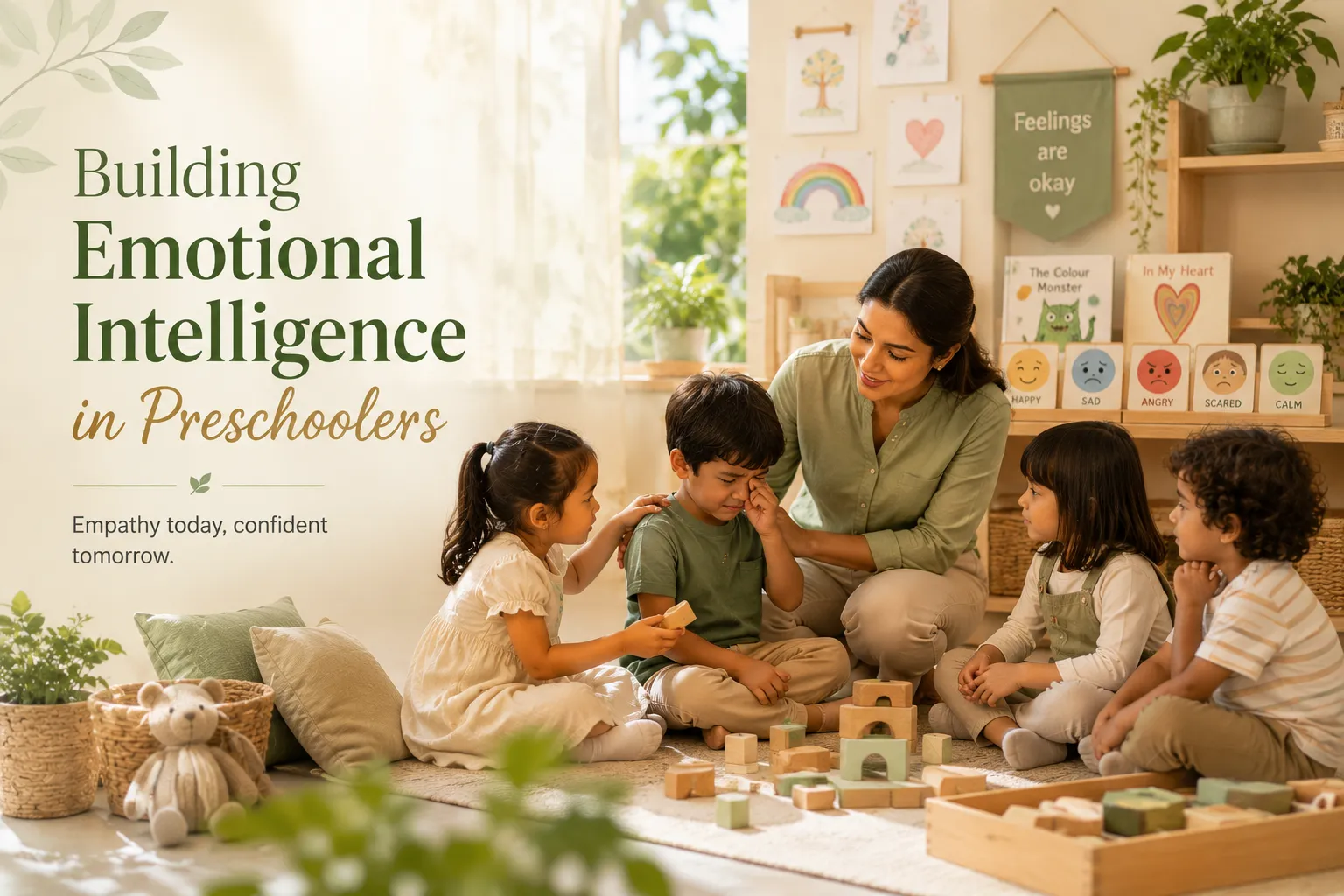
Learn how to build emotional intelligence in preschoolers with practical parenting strategies that strengthen empathy, resilience, self-regulation, confidence, and social skills.




Emotional intelligence is one of the most important skills children develop during the early years. By helping preschoolers recognise emotions, manage feelings, build empathy, and develop healthy relationships, parents and educators lay the foundation for confidence, resilience, positive mental wellbeing, and lifelong success.
If you have a preschooler at home, chances are your day includes dramatic meltdowns over broken biscuits, the ‘wrong’ colour cup, or a sandwich that is ‘not cut properly’.
While we focus on teaching ABCs, counting, and pencil skills, emotional intelligence is just as important — helping children understand emotions, express them safely, and connect with others.
In today’s fast-moving world, EQ may matter more than IQ for relationships, confidence, resilience, and mental wellbeing. The good news? Preschool years are the perfect time to start.
What Is Emotional Intelligence?
In early childhood education, emotional intelligence supports social-emotional learning (SEL), self-regulation, communication, and positive behaviour. Research consistently shows that emotionally secure children are better equipped to manage challenges, build friendships, and succeed both academically and socially.
Emotional intelligence is the ability to:
- Recognise emotions
- Understand feelings
- Manage reactions
- Show empathy
- Build healthy relationships
For young children, it could look like:
- Saying “I’m angry” instead of hitting someone
- Waiting for a turn
- Comforting a crying friend
- Understanding that everyone has feelings
Of course, this does not and cannot happen overnight. Like literacy and numeracy, emotional intelligence develops gradually through everyday experiences, supportive relationships, and consistent guidance from caring adults.
Why Early Years Matter
Research consistently shows that the first six years of life are a deeply formative period, with emotional development playing a critical role. Children who learn emotional skills early often perform better socially and academically over time.
Modern neuroscience also shows that young brains quickly develop pathways for self-control, empathy, and emotional regulation. Helping children manage big feelings early strengthens their brain’s ‘calm-down system.’
Developing emotional intelligence during the preschool years also strengthens executive functioning skills such as attention, impulse control, flexible thinking, and problem-solving.
Research increasingly shows that emotionally secure children often:
- Adapt better to school
- Form healthier friendships
- Handle stress more effectively
- Show stronger focus and problem-solving
Teachers frequently say that children who can manage emotions tend to thrive socially and academically.
So yes, teaching your child to identify feelings is just as valuable as teaching Math.
Maybe more.
When emotional wellbeing is nurtured alongside academic learning, children are more likely to become confident, resilient learners who enjoy positive relationships throughout life.
“Stop Crying” Isn’t Emotional Coaching
Many parents grew up hearing things like:
- “Bas drama band karo.”
- “Boys don’t cry.”
- “Be a good girl.”
- “You’re fine.”
- “Log kya kahenge?”
Most parents were doing their best with the tools they had. But today we know that dismissing emotions doesn’t make them disappear — it only teaches children to hide them. Children need emotional coaching, not emotional silencing.
Emotion coaching helps children understand that all feelings are valid, even though not all behaviours are acceptable. This balance supports healthy emotional regulation and positive discipline.
Emotional coaching does NOT however mean permissive parenting or allowing wild behaviour in the name of ‘gentle parenting.’
You can say: “I understand you are angry, but you cannot hit.” That’s emotional intelligence with boundaries — the ultimate combo.
Setting clear, consistent boundaries while acknowledging emotions helps children develop self-control without feeling misunderstood.
Practical Ways to Build Emotional Intelligence at Home
Parents play the most important role in developing emotional intelligence because everyday interactions provide countless opportunities to model empathy, communication, resilience, and emotional regulation.
1. Name Feelings Frequently
Young children need vocabulary for emotions.
Instead of: “Why are you behaving like this?”, try labelling the feeling for them.
- “You seem frustrated.”
- “Are you feeling disappointed?”
- “That made you excited!”
The more emotional language they hear, the more they learn to identify with their inner world. Building an emotional vocabulary enables children to express their needs more clearly and reduces frustration caused by not having the right words.
2. Don’t Rush to Fix Everything
Parents naturally want to stop tears immediately, but sometimes children need connection before solutions.
Instead of: “Nothing happened.” Try: “I know that felt upsetting.”
Validation calms children because they feel understood — it does NOT mean approving of their behaviour. When children feel heard and understood, they internalise the belief: ‘My feelings matter.’ This becomes the foundation of healthy self-worth. Feeling understood strengthens trust, emotional security, and the confidence to communicate openly in the future.
You can validate feelings while still setting limits.
3. Model Emotional Regulation Yourself
Children learn emotional habits by watching adults, and if parents constantly shout, panic, or suppress emotions, children absorb those patterns.
This doesn’t mean you must be a permanently calm yoga instructor! It means recognising that you cannot pour calm from an empty cup and modelling healthy repair: “I was frustrated and I shouted. I’m sorry. I’ll try again.” This teaches accountability and emotional recovery.
When both parents (fathers included!) express emotions, apologise, show affection, and model calm behaviour, children learn that emotions are human.
Children learn emotional intelligence by observing adults far more than by listening to instructions. Modelling calm problem-solving and healthy emotional expression has a lasting impact.
4. Connect as a family
Emotional intelligence grows through relationships, and small daily rituals matter more than expensive toys.
- Bedtime chats
- Family hugs
- Gratitude sharing at dinner
- ‘Best and hardest part of the day’ conversations
- Reading together
Even 10-15 minutes of fully present attention can strengthen emotional security!
Consistent family routines also strengthen attachment, communication, emotional resilience, and a child's sense of belonging.
5. Teach Calm-Down Skills Before Meltdowns
Children cannot learn emotional skills in the middle of a full tantrum tornado.
Practice calming strategies during peaceful moments:
- Deep breathing
- Counting slowly
- Hugging a pillow
- Sensory play
- Self-expression (drawing etc)
- Quiet corners
- Listening to calming music
Over time, these tools help children regulate emotions independently. Practising calming techniques before children become overwhelmed makes it easier for them to use these strategies during challenging moments.
6. Encourage Empathy in Everyday Situations
Empathy develops gradually. Ask simple reflective questions:
- “How do you think Didi felt?”
- “What can we do if someone is sad?”
- “How would you feel if that happened to you?”
Stories, pretend play, and sibling interactions are excellent opportunities for empathy-building. Books, storytelling, role play, and everyday conversations all provide meaningful opportunities to develop empathy and perspective-taking.
7. Reduce Emotional Overload
Modern children are often overstimulated.
Too many activities, screens, rushed schedules, and constant performance pressure can overwhelm young nervous systems.
Young children need:
- Unstructured play
- Outdoor time
- Boredom
- Rest
- Slow conversations
Not every child needs a coding class in the evenings, puddle jumping is enough! Balanced routines that include outdoor play, rest, creativity, and free play support children's emotional wellbeing and reduce unnecessary stress.
The Role of Play in Emotional Development
Early childhood experts have consistently emphasised the importance of play for emotional growth and building skills like:
- Cooperation
- Problem-solving
- Frustration tolerance
- Imagination
- Social negotiation
Pretend play is especially powerful because children ‘practice’ emotions safely.
Play-based learning allows children to explore emotions, solve conflicts, build resilience, and strengthen social-emotional skills in developmentally appropriate ways.
When your child makes stuffed animals fight over imaginary chocolates, important emotional learning is happening.
Signs Your Preschooler Is Developing Emotional Intelligence
Your child may already be building EQ if they:
- Try to name feelings
- Show concern when someone is upset
- Recover faster after tantrums
- Begin using words instead of aggression
- Understand simple social cues
- Attempt problem-solving
- Express preferences calmly (even occasionally)
Emotional development is not linear.
A child may share toys beautifully one day and scream “MINE!” like a tiny dragon the next. That’s normal.
Progress matters more than perfection.
Every child develops emotional intelligence at their own pace, and consistent support from parents and educators makes a meaningful difference over time.
What About Tantrums?
Tantrums are developmentally normal in preschool years.
Young children have:
- Big emotions
- Limited impulse control
- Immature brains
- Small vocabularies
- Huge opinions
An explosive combination indeed!
Tantrums are a normal part of child development and often decrease as children develop stronger language, self-regulation, and emotional coping skills.
During tantrums:
- Stay calm if possible
- Keep children safe
- Use fewer words
- Offer connection after calming down
- Avoid lectures during emotional storms
A dysregulated child cannot absorb life lessons.
Children learn best after they feel calm, safe, and emotionally connected to the adults supporting them.
Progress Over Perfection
Parenting today comes with enormous pressure. Social media shows perfectly calm mothers making rainbow-shaped rotis in spotless homes while discussing mindful parenting. Real life is different.
Some days you respond patiently; other days you negotiate with a screaming child while holding leaking grocery bags in the scorching heat. Both are normal. Children do not need perfect parents — they need emotionally available ones.
Strong emotional connections—not perfect parenting—provide children with the security they need to learn, grow, and develop resilience.
The goal is not raising children who never cry, get angry, or misbehave in public, but children who: feel safe expressing emotions, have healthy coping skills, build empathy, develop resilience, and trust that home is a safe place.
And that journey starts with small everyday moments, especially the ones involving broken biscuits.
Final Thoughts
Emotional intelligence is not a ‘soft skill’ - it is a life skill.
When we help young children understand emotions, we are not just preventing tantrums and meltdowns — we are helping build future adults who can communicate, connect, adapt, and thrive.
Emotional intelligence is a lifelong skill that supports healthy relationships, effective communication, academic success, leadership, and overall wellbeing well beyond the preschool years.
Which means your efforts today may shape generations to come.
After all, the real sign of maturity is not age — it is having tools to survive all the drama that daily life brings!
Frequently Asked Questions
What is emotional intelligence in preschoolers?
Emotional intelligence in preschoolers is the ability to recognise, understand, express, and manage emotions while responding appropriately to the feelings of others. During the early years, children begin learning skills such as self-regulation, empathy, communication, and problem-solving through everyday interactions, play, and supportive relationships. These foundational abilities help children build confidence, form healthy friendships, and navigate challenges both at home and in school.
Why is emotional intelligence important for young children?
Emotional intelligence is important because it helps young children understand their emotions, build positive relationships, and develop resilience. Children with strong emotional skills are often better able to manage frustration, communicate their needs, cooperate with others, and adapt to new situations. Emotional intelligence also supports school readiness by improving attention, self-control, confidence, and social-emotional wellbeing.
How can parents build emotional intelligence at home?
Parents can build emotional intelligence by talking openly about feelings, modelling calm behaviour, validating emotions, and encouraging children to express themselves respectfully. Reading stories, engaging in pretend play, asking reflective questions, and practising problem-solving together all help children develop empathy and emotional awareness. Consistent routines, patient guidance, and positive relationships create a safe environment where emotional skills can flourish.
What are the signs of emotional intelligence in preschoolers?
A preschooler developing emotional intelligence may begin naming their feelings, showing empathy when someone is upset, using words instead of aggression, taking turns, recovering more quickly after disappointment, and recognising how their actions affect others. Emotional development varies from child to child, so steady progress over time is far more important than expecting perfect behaviour every day.
How does play support emotional development?
Play is one of the most effective ways children develop emotional intelligence because it allows them to explore feelings, solve problems, and practise social interactions in a safe environment. Through imaginative play, role-playing, storytelling, and cooperative games, preschoolers learn empathy, patience, communication, resilience, and emotional regulation while making sense of real-life experiences in a way that feels natural and enjoyable.
How can I help my child manage big emotions?
Helping children manage big emotions begins with staying calm, acknowledging their feelings, and teaching healthy ways to express them. Naming emotions, practising deep breathing, encouraging sensory play, reading books about feelings, and creating quiet spaces for calming down all help children develop self-regulation. Over time, these strategies give children the confidence to handle frustration, disappointment, and excitement more independently.
Are tantrums a normal part of emotional development?
Yes. Tantrums are a normal part of early childhood development because young children are still learning to manage strong emotions and communicate their needs. Their brains are developing rapidly, but self-control and emotional regulation take time to mature. Responding with patience, consistency, and empathy helps children feel secure while gradually learning healthier ways to cope with overwhelming feelings.
Can emotional intelligence improve school readiness?
Yes. Emotional intelligence plays a significant role in school readiness because it helps children listen, follow routines, manage emotions, solve problems, and build positive relationships with teachers and classmates. Preschoolers who develop emotional awareness and self-regulation often adapt more easily to classroom environments, participate confidently in learning activities, and approach new experiences with greater resilience and curiosity.