
Early Maths Skills for Preschoolers: Counting, Sorting & Patterns
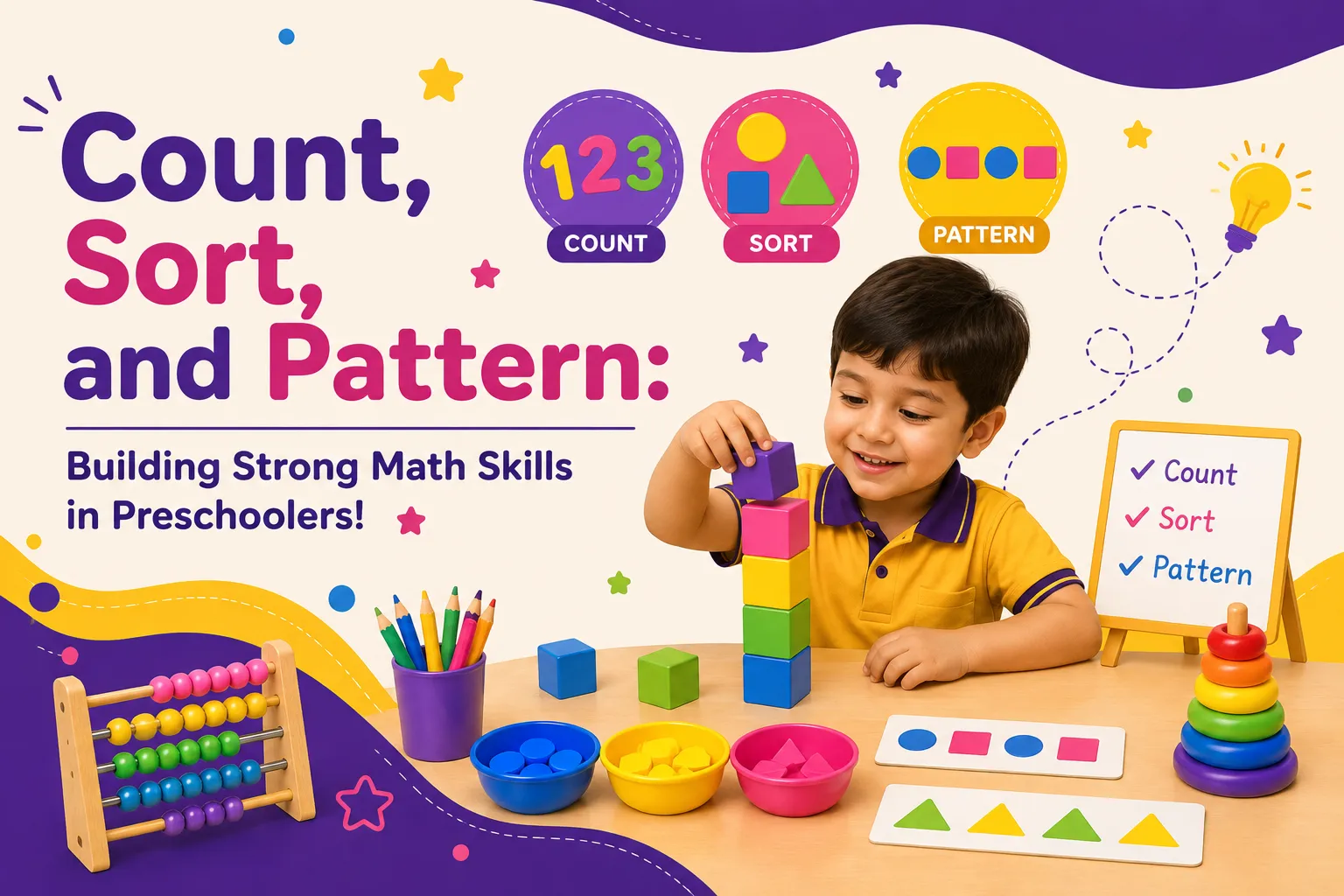
Discover fun ways to teach early maths skills to preschoolers through counting, sorting and pattern activities that build number sense, logic and school readiness.




Early maths skills for preschoolers begin with simple concepts such as counting, sorting, number recognition and patterns. Math is a fundamental subject that is essential for children to learn at a young age. Early math skills, specifically counting, sorting, and patterns, are the building blocks for a child's mathematical understanding. As parents and educators, it is important to introduce these concepts to preschool children in a fun and engaging way. In this blog, we will discuss the importance of early math skills and provide some tips on how to teach counting, sorting, and patterns to preschoolers.
Why Are Early Maths Skills Important for Preschool Children?
Developing early math skills can have a significant impact on a child's academic success and overall development. These skills not only help children understand basic mathematical concepts but also lay the foundation for more complex math concepts in the future.
Early maths skills also help preschoolers develop number sense, logical thinking, problem-solving, observation, spatial awareness and the ability to recognise relationships between objects. These skills form an important foundation for later learning in mathematics and everyday decision-making.
Counting: Building Early Number Sense
Counting is one of the first math skills that children learn. It involves understanding the concept of numbers and being able to recite them in order. Counting helps children develop number sense, which is essential for solving math problems later on.
For preschoolers, counting is more than simply saying numbers in sequence. It also involves learning that each object is counted once, understanding that the last number represents how many objects are in a group, and connecting number words with quantities.
Tips for teaching counting to preschoolers:
-
Use visuals: Preschoolers are visual learners, so it is important to use visuals like counting blocks or pictures to help them understand the concept of counting.
-
Counting songs and rhymes: Children love music and rhymes, so incorporating counting songs and rhymes into their daily routine can make learning more fun and engaging.
-
Everyday objects: Encourage your child to count everyday objects like toys, fruits, or even steps while climbing the stairs. This will help them understand the real-life application of counting.
-
Counting games: Make learning fun by playing counting games such as “I Spy” or “Counting objects in a jar”. These games not only help children practice their counting skills but also improve their concentration and memory.
You can also ask simple questions such as “How many blocks do you have?” or “Can you give me three apples?” These activities help children connect spoken numbers with real quantities.
Sorting: Developing Classification and Logical Thinking
Sorting is the process of organizing objects based on their similarities or differences. It helps children develop logical thinking skills and improves their ability to classify and categorize things.
Sorting activities for preschoolers introduce early classification skills. Children learn to notice similarities and differences and organise objects according to attributes such as colour, shape, size, texture or function.
Tips for teaching sorting to preschoolers:
-
Start with colours and shapes: Sorting by colour and shape is an easy way to introduce the concept of sorting to preschoolers. Use objects like blocks, buttons, or toys that come in different colours and shapes to make learning more fun.
-
Use everyday objects: Encourage your child to sort everyday objects like utensils, clothes, or toys according to their size, shape, or function.
-
Sorting games: Incorporate sorting games into your child's playtime. Games like “Find the Odd One Out” or “Kiddie Memory” are not only fun but also help children practice their sorting skills.
-
Sort and graph: As children get older, you can introduce them to more complex sorting activities like sorting objects based on their size, shape, or colour and then graphing them on a chart.
Try asking children to explain why they placed an object in a particular group. This encourages mathematical language, reasoning and early critical-thinking skills rather than simply asking them to find the correct answer.
Patterns: Introducing Early Mathematical Thinking
Patterns are sequences of repeated objects or shapes. Understanding patterns is crucial for developing a child's problem-solving skills and critical thinking abilities.
Recognising and creating patterns helps preschoolers notice relationships, predict what comes next and understand sequence. These early pattern-recognition skills support later mathematical reasoning.
Tips for teaching patterns to preschoolers:
-
Start with simple patterns: Begin with simple patterns like ABAB or ABCABC before moving on to more complex ones. Use objects such as blocks, beads, stickers or even fruits to create patterns.
-
Visual aids: Visual aids like pattern cards or pattern blocks can help children visualise and understand different types of patterns.
-
Create patterns in daily activities: Encourage your child to create patterns in daily activities like stacking blocks or arranging toys in a specific order.
-
Pattern games: Games like “Pattern Bingo” or “Pattern Puzzles” are great for practicing pattern recognition skills in a fun way.
Once children recognise a pattern, ask “What comes next?” and “How do you know?” These simple questions encourage prediction, reasoning and communication.
Fun Early Maths Activities for Preschoolers
Counting, sorting and pattern activities do not need to feel like formal lessons. Everyday play provides many opportunities to introduce early maths concepts naturally.
Parents and educators can try:
-
Counting toys, blocks, steps or pieces of fruit.
-
Sorting toys by colour, shape or size.
-
Creating patterns with blocks, beads, leaves or household objects.
-
Matching objects with the same colour or shape.
-
Comparing groups by asking which has more or fewer objects.
-
Arranging objects from smallest to largest.
-
Finding shapes during walks around the neighbourhood.
-
Using songs, rhymes and movement games to practise numbers and sequences.
The aim is not to make preschoolers memorise mathematical rules. It is to help them notice numbers, quantities, relationships and patterns through meaningful experiences.
How Parents Can Build Early Maths Skills at Home
Parents can support early maths development without worksheets or expensive learning resources. Simple conversations and play-based activities can make mathematics part of everyday life.
For example:
-
Ask your child to count plates while setting the table.
-
Sort laundry by colour or type.
-
Compare which fruit is bigger or smaller.
-
Count steps while walking upstairs.
-
Create patterns while arranging toys.
-
Look for circles, squares and rectangles around the home.
-
Ask “How many are left?” when sharing snacks or toys.
Giving children time to think and explain their answers is just as important as getting the answer right.
Early Maths and School Readiness
Early maths skills contribute to school readiness by helping children develop concentration, reasoning, language, memory and confidence when working with numbers and information. Children who have regular opportunities to count, sort, compare and recognise patterns begin school with valuable mathematical foundations.
Play-based early learning gives children opportunities to practise these skills in ways that are active, social and meaningful.
How to Make Maths Fun for Preschoolers
Young children learn best when they are actively involved. Keep maths activities short, playful and connected to things children already enjoy. Avoid turning every activity into a test. Instead, encourage children to make predictions, explain their thinking, try again and discover different ways to solve a problem.
Praise effort, curiosity and persistence rather than only correct answers. This helps children develop a positive attitude towards mathematics from an early age.
Key Takeaways
-
Counting helps preschoolers develop early number sense and understand quantities.
-
Sorting develops classification, observation and logical-thinking skills.
-
Patterns help children recognise relationships, sequences and predict what comes next.
-
Play-based maths activities can make early learning enjoyable and meaningful.
-
Everyday objects can become effective tools for teaching early maths at home.
-
Early maths skills support problem-solving, concentration, communication and school readiness.
-
Children learn at different rates, so encouragement and exploration are more important than pressure.
Conclusion
In conclusion, early math skills play a crucial role in a child's overall development. Counting, sorting, and patterns are the foundation for more advanced mathematical concepts and it is important to introduce these concepts to preschool children in an interactive and fun manner. By incorporating these tips into your child's daily routine, you can help them develop a strong mathematical foundation that will benefit them in the long run. So, let's make learning math fun and exciting for our little ones!

FAQs
What are the most important early maths skills for preschoolers?
How can I teach counting to my preschooler?
How do sorting activities help preschoolers?
Why are patterns important in early childhood maths?
What are some easy maths activities for preschoolers at home?
At what age should children start learning maths?
How can parents improve their child's early maths skills?
How do counting, sorting and patterns prepare children for school?
Should preschoolers use worksheets to learn maths?
How can I make maths fun for a preschool child?
What are the most important early maths skills for preschoolers?
How do sorting activities help preschoolers?
What are some easy maths activities for preschoolers at home?
How can parents improve their child's early maths skills?
Should preschoolers use worksheets to learn maths?
How can I teach counting to my preschooler?
Why are patterns important in early childhood maths?
At what age should children start learning maths?
How do counting, sorting and patterns prepare children for school?
How can I make maths fun for a preschool child?