
Fun Ways to Teach Colours and Shapes to Kids and Preschoolers
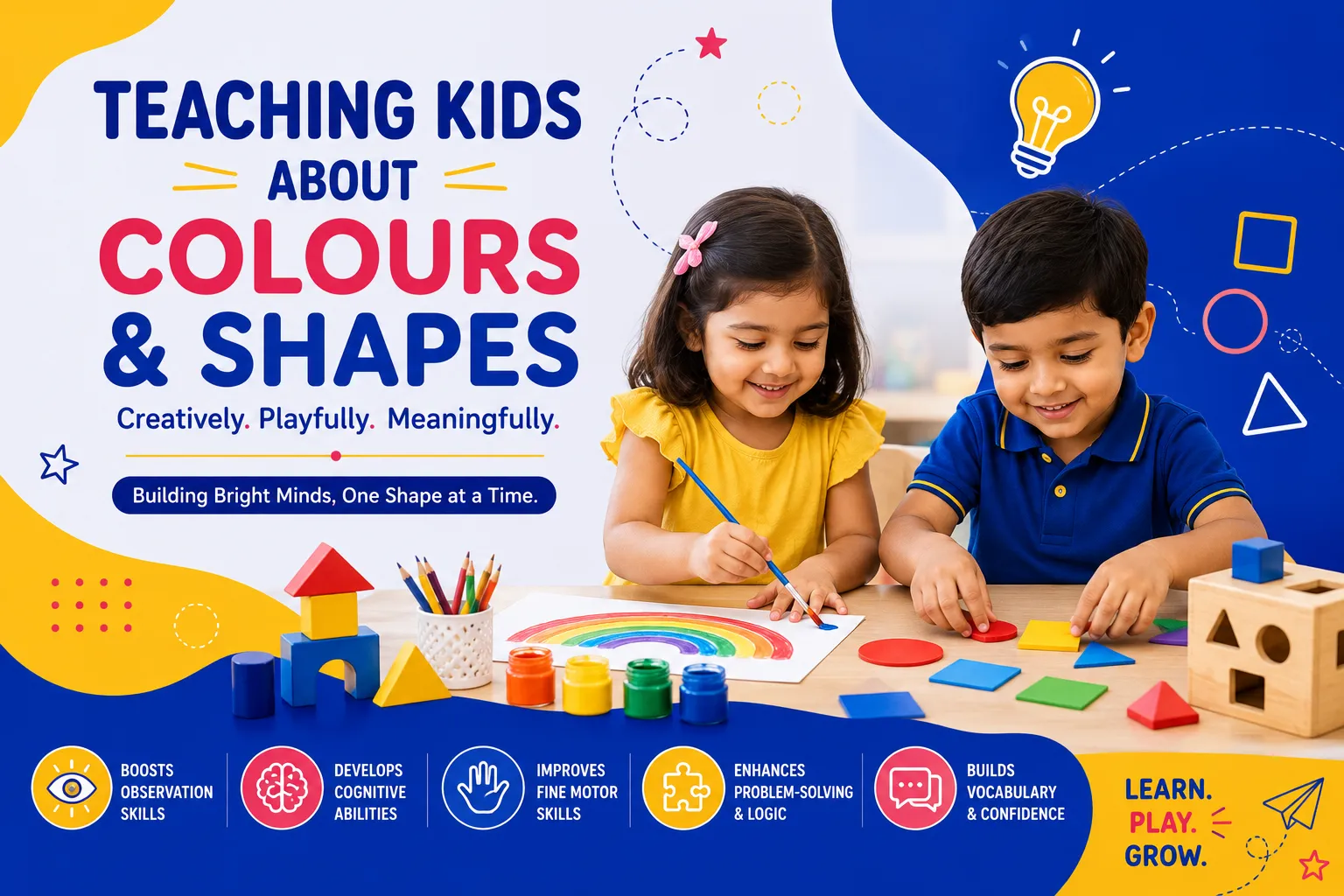
Discover fun, play-based activities to teach colours and shapes to toddlers and preschoolers while developing cognitive skills, language, creativity and school readiness.




Learning colours and shapes is one of the earliest milestones in child development. Through play, exploration, storytelling, art and everyday experiences, toddlers and preschoolers develop colour recognition, shape recognition, visual perception, language skills, early mathematical thinking and problem-solving while building confidence and curiosity.
The early years of a child's life are filled with discovery, curiosity, and imagination. Among the first concepts children learn are colours and shapes, which form the building blocks for future learning in mathematics, reading, art, and everyday observation.
These early concepts also support school readiness by helping children recognise patterns, classify objects, compare similarities and differences, and describe the world around them using increasingly rich vocabulary.
Children begin noticing colours and basic shapes from infancy, but most start identifying and naming them between the ages of 2 and 4 years. Every child develops at their own pace, so it is important to focus on playful exploration rather than expecting perfect recognition.
Children learn best when colours and shapes are introduced naturally through meaningful experiences rather than formal lessons or memorisation.
Why Learning Colours and Shapes Matters
Recognising colours and shapes is more than an academic milestone. It helps:
- Improve visual perception and observation skills.
- Build vocabulary and communication abilities.
- Develop problem-solving and critical thinking.
- Strengthen memory and concentration.
- Prepare for early maths concepts like sorting, patterns, and geometry.
- Develop visual discrimination and spatial awareness.
- Strengthen early classification and sequencing skills.
- Support school readiness through play-based learning.
Recognising colours and shapes also helps children make sense of their surroundings, organise information, and communicate their ideas more confidently.
How to Teach Colours and Shapes Effectively
Make learning a part of everyday life.
Encourage children to notice colours and shapes during daily routines.
Ask questions while grocery shopping, identify the shape of road signs during walks, or discuss the colours of fruits and flowers at home.
Encourage children to describe what they see and explore independently rather than memorising answers. Everyday conversations reinforce learning naturally.
Focus on introducing one or two colours or shapes at a time before gradually expanding children's understanding through repetition and everyday experiences.
Repeat concepts regularly through different activities. The more children interact with concepts in different contexts, the better they understand and remember them.
Praise curiosity, observation and effort instead of expecting children to identify every colour or shape correctly. Positive experiences encourage lifelong learning.
Fun Ways of Teaching Colours to Kids
Colour recognition develops naturally when children actively explore, compare and talk about the colours they see every day.
Creative play is one of the best approaches for teaching colours to kids. Young learners are naturally drawn to bright objects, making colour recognition an exciting experience.
Here are some engaging ideas:
Colour Treasure Hunt
Ask children to find objects of a particular colour around their environment. They can collect red toys, blue books, or green leaves, making learning active and memorable.
Encourage children to explain why they chose each object to strengthen vocabulary and observation skills.
Finger Painting
Painting allows children to experiment with colours and improve fine motor skills. Encourage mixing of primary colours and discovering new shades through hands-on exploration.
This activity also encourages creativity, sensory exploration and fine motor development.
Sorting Games
Provide colourful buttons, blocks, pom-poms, or paper cut-outs and ask children to sort them into matching colour groups. This simple activity strengthens both colour recognition and classification skills.
As children become more confident, encourage them to sort objects by both colour and size to introduce early mathematical thinking.
Colour Story Time
Choose picture books with vibrant illustrations and encourage children to identify colours throughout the story. Reading and colour recognition work together to improve vocabulary and observation.
Ask open-ended questions such as "What colour do you think comes next?" or "Can you find another green object?" to encourage conversation.
Creative Preschool Shapes Activities
Shape recognition develops best through hands-on experiences that allow children to touch, build, compare and create.
Learning shapes becomes much more exciting when children can touch, build, and create through hands-on exploration that strengthens spatial awareness.
Shape Collages
Provide coloured paper cut into circles, squares, rectangles, triangles, and stars. Children can create houses, animals, trees, or vehicles using different shapes.
Shape Stamping
Use foam shapes, stamps, or building blocks dipped in washable paint to create colourful shape patterns.
Shape Walk
Take children outdoors and ask them to spot shapes in the environment. Wheels become circles, windows become rectangles, and roof tops become triangles.
Encourage children to notice shapes at home, in parks, on buildings and during travel to reinforce learning in different environments.
Shape Matching Cards
Create simple matching games where children pair identical shapes or match everyday objects with their corresponding geometric shape.
Matching activities strengthen memory, visual discrimination and logical thinking.
These enjoyable activities make abstract concepts easier to understand.
Exciting Shapes Learning Activities
Movement-based learning keeps children engaged while helping them remember new concepts more effectively.
Interactive shapes learning activities keep children engaged while reinforcing important concepts.
Build with Blocks
Building towers, bridges, and houses introduces children to different shapes while improving creativity and problem-solving skills.
Building activities also develop spatial reasoning, creativity and engineering thinking through play.
Shape Hopscotch
Draw different shapes on the ground instead of traditional hopscotch squares. Call out a shape and have children jump to it. This combines movement with learning.
Combining movement with learning strengthens memory, coordination and concentration.
Shape Puzzles
Wooden puzzles or homemade cardboard puzzles help children recognise shapes while developing hand-eye coordination.
Playdough Creations
Children can roll, flatten, and cut playdough into circles, hearts, stars, squares, and other shapes using cookie cutters or safe plastic tools.
Manipulating playdough strengthens hand muscles needed for writing and other fine motor tasks.
These activities encourage experimentation while making learning feel like play.
Everyday Activities for Shapes Learning
Everyday household items offer countless learning opportunities. For example:
- Arrange snacks into different shapes before eating.
- Build simple shape patterns using LEGO bricks.
- Identify shapes while cooking with cookie cutters.
- Sort laundry by colour while discussing the shapes of clothing items.
- Use chalk to draw shapes outdoors and encourage children to trace or colour.
When children see shapes in real-life situations, learning is more meaningful.
Everyday routines provide countless opportunities to reinforce learning without making it feel like a lesson.
Combining Colours and Shapes Through Play
A very effective teaching strategy is to combine concepts of colours and shapes.
For example, ask questions like:
- ‘Can you find a blue circle?’
- ‘Which block is the yellow square?’
- ‘Can you build a house using a red rectangle and a green triangle?’
Activities like these strengthen listening, observation, and language skills while encouraging children to think carefully about multiple characteristics at once.
These activities also strengthen listening skills, working memory and the ability to follow multi-step instructions.
Arts and crafts also provide excellent opportunities for combining concepts. Children can create colourful mosaics, decorate shape cut-outs, or build pictures using geometric pieces.
Encouraging Independent Learning
Do not combine too many colours or shapes at once.
Give them opportunities to make choices, ask questions, and explain their thinking.
Simple prompts such as ‘Why do you think this is a circle?’ or ‘Can you find something else that's yellow?’ promote conversation and critical thinking. Allow children enough time to observe, think and respond independently before offering help. This builds confidence and problem-solving skills. Celebrate effort instead of perfection, helping children build confidence as they learn.
Final Thoughts
With creative games, storytelling, crafts, outdoor exploration, and everyday conversations, children naturally develop essential skills while having fun.
When learning is woven into daily life, children become active participants in their own discovery. By making colours and shapes part of play, creativity, and exploration, parents and educators can lay a strong foundation for future academic success while nurturing a lifelong love for learning.
Most importantly, learning colours and shapes should be joyful. Every conversation, drawing, nature walk and creative activity becomes an opportunity for children to observe, explore and discover the world around them with confidence and curiosity.
If you're looking for an early childhood education programme that nurtures curiosity through hands-on, play-based learning, explore Kidzee's preschool programmes designed for every stage of your child's development. You can also discover expert parenting resources, early learning tips and activities that support your child's growth at home and in the classroom.

FAQs
At what age do children learn colours and shapes?
Why is learning colours and shapes important for preschoolers?
What are the best activities to teach colours to children?
How can I teach shapes to my toddler through play?
How do colours and shapes support school readiness?
Should children learn colours before shapes?
How often should children practise colours and shapes?
What is the best way to teach colours and shapes?
At what age do children learn colours and shapes?
What are the best activities to teach colours to children?
How do colours and shapes support school readiness?
How often should children practise colours and shapes?
Why is learning colours and shapes important for preschoolers?
How can I teach shapes to my toddler through play?
Should children learn colours before shapes?
What is the best way to teach colours and shapes?